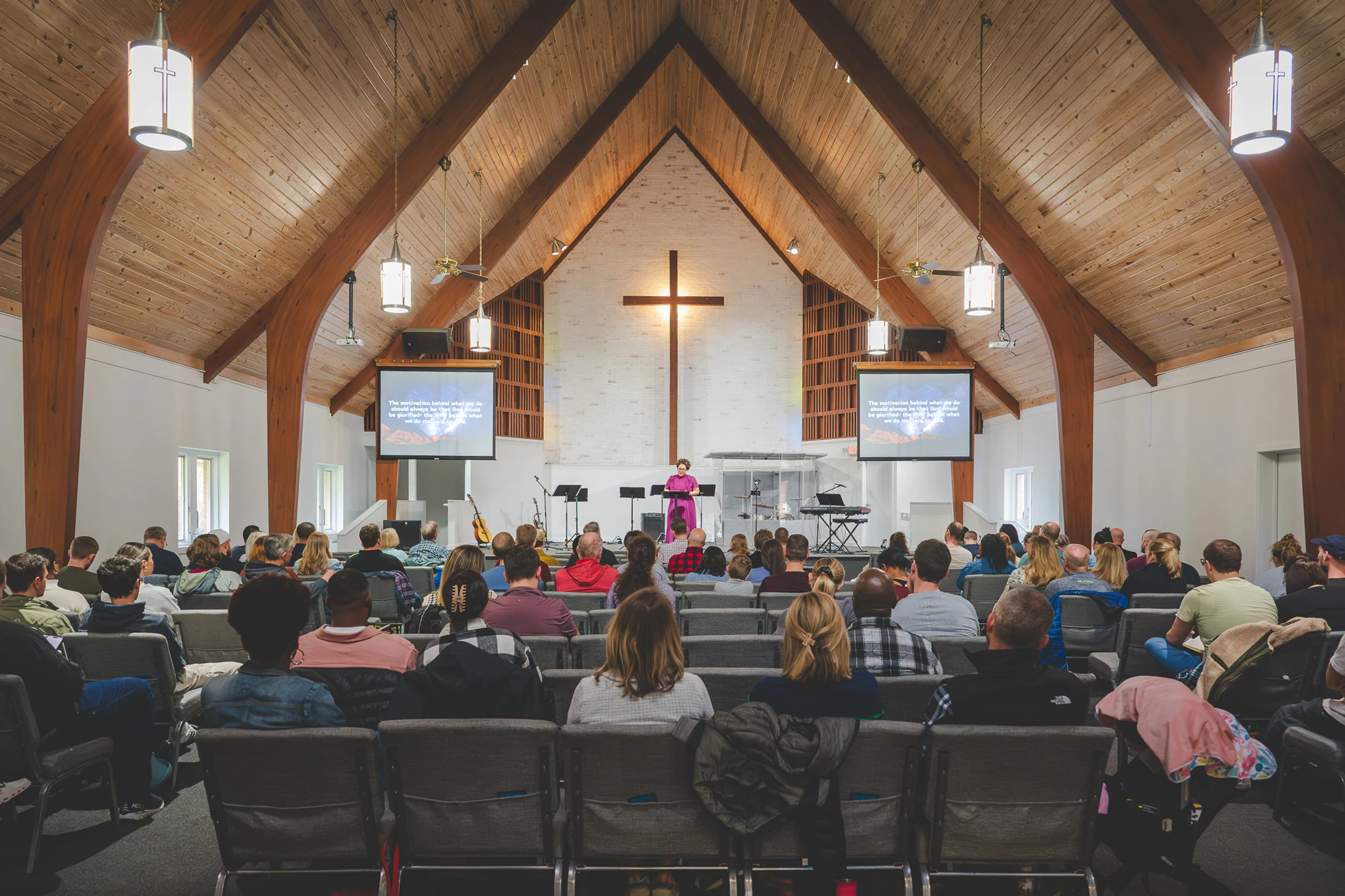
We can't wait to see you
Join us this Sunday at 10:00 a.m. for our morning worship!


Jesus is walking by. He turns. He looks right at you. And he asks the most disruptive question in all of spiritual formation: What do you want?
It sounds simple. But if you sit with it long enough, you'll realize how hard it actually is to answer — and how much it reveals about where you really are in your faith.
In this message, Pastor Rich Johnson continues the new series through the Gospel of John, taking us into one of the most intimate scenes in all of Scripture. Two disciples begin following Jesus, and instead of a grand introduction or a miraculous sign, Jesus simply turns around and asks what they're looking for. What happens next is an invitation that changes everything — not just for them, but for us.
In this message you'll learn:
Whether you're brand new to faith or have been following Jesus for decades, this message will challenge you to stop looking for a Jesus you can control and start getting close to the Jesus who already knows your name.
📖 Scripture: John 1:35-42 | Matthew 16:13-18
Last week we started a sermon series through the Gospel of John on Easter Sunday. And the Gospel of John is the fourth gospel mentioned in order in your New Testament Bibles: Matthew, Mark, Luke, and John. The word gospel in the Greek is euangelion. Everybody say euangelion. Yeah, euangelion. And that word simply means good news. This is a particular form of writing in the ancient Near East, that the gospel, the good news about Jesus, is a story that is good. And this good is not advice. If it were just good advice, it's something you could take and then you could apply whenever it felt comfortable for you to apply it. It's also not good philosophy. It's not just an idea or a concept that could evolve over time but have very little application or challenge your application. It is good news. It is both something that is powerful and dynamic, much more than advice, something powerful and dynamic, much more than a philosophy. The good news of these gospels, Matthew, Mark, Luke, and John, is that they are about a person. It's not advice. It's not ideas. It is embodied in the person of Jesus Christ. And what John does in his gospel, different from Matthew, is that he doesn't start with a genealogy of where Jesus came from. He doesn't start like Mark with something dynamic that Jesus does that wows people. He doesn't give us a birth narrative like Luke does. John instead gives us the mystery of who Jesus is. In the beginning was the Word, And the Word was God, and the Word was with God. And then we get in verse 14, we see what John's Gospel, his euangelion, is all about. The Word became flesh. And in so doing, John is connecting the divinity of Jesus and the humanity of Jesus together. The Gospel of John was written around, uh, 90 AD. And what was happening around 90 AD in this area of Palestine is that one, Jerusalem had fallen. Secondly, the temple had been destroyed. And then thirdly, those people of the way— they call themselves Christians— they were being kicked out of synagogues and not welcome in Greek or Roman communities.
They were wandering around trying to find their way, trying to find their grounding. And what was troubling within the Christian community at this time is that because the crisis was so tenuous, because things were so hellacious about what they were experiencing, the teaching about Jesus at this time was that Jesus was divine and not so much human. They would emphasize his divinity over and against his humanity. And John writes in that crisis that we must not forget about the humanity of Jesus, that Jesus is the Son of God, but Jesus is also the Son of Man, and that to connect these two together is not to negate one over the other, that we don't become so heavenly minded that we are no earthly good, but also that we are focused on this earthly realm and forget where this King and Messiah and Christ has come from. He wants to connect both together. And when you read the Gospel of John, you read these stories of Jesus's humanity that wow our idea of his divinity. And his divinity that causes us to pause in our tracks when we see that it's coming through flesh and through blood. And John's storytelling is an invitation for us all, then and now, to enter into the story of this divine mystic who became flesh. We pick up here in John chapter 1, verse 35. And I know you just sat down, Danny and Lydia, but we're all going to stand together right with you. So you get to be—
you came right in on the right time. You came right in on the right time. John chapter 1, verse 35 through 42, together. The next day, John was standing with of his disciples. When he saw Jesus passing by, he said, 'Look, the Lamb of God!' The two disciples heard him say this and followed Jesus. When Jesus turned and noticed them following him, he asked them, 'What are you looking for?' They said to him, 'Rabbi'—which means teacher—'where are you staying?' 'Come and you'll see,' he replied. So they went and saw where he was staying, and they stayed with him that day.
It was about 4 in the afternoon. Andrew, Simon Peter's brother, was one of the two who heard John and followed him.
He first found his own brother Simon and and told him, we have found the Messiah, which is translated the Christ. And he brought Simon to Jesus. When Jesus saw him, he said, you are Simon son of John. You will be called Cephas, which is translated Peter. This is the word of the Lord. And the people said, thanks be to God. Let this word fill our minds, flow from our mouths, and free our hearts to live as the beloved children of God.
You can take a seat.
The title of the message today is very simply, 'What Do You Want?' What do you want? The disciples in this story are not skeptics. They're not non-believers. In fact, they are believers. They are disciples of the one called John the Baptist, not to be confused with John the disciple who wrote this gospel. And as they were following John the Baptist and hearing his message of repentance, he consistently told them that he was not the one that ultimately they would follow. That they would ultimately follow someone whose shoes John wasn't even worthy to lace up. And as they were walking, John sees him. And almost under his breath, he says, "There he is, the Lamb of God, the one who will come and take away the sins of the world." Now, John is describing to these disciples who to look for because there were lots of questions about who these early Jewish believers were actually looking for. They were looking for a Messiah, but they were looking for a Messiah in the profile of King David. Somebody who would be like a warrior and would come and restore balance to the force with force. He would restore the kingdom of Israel, and Israel would once again be at the height and center of of the universe. Or maybe they were looking for a Messiah not like a warrior king David, but like his son, wise Solomon, who was so wise in fact that he grew the kingdom of Israel to be its wealthiest and most prominent.
So much of a spectacle that people would come from around the world to look just at their kingdom.
They would be the center center of all of the kingdoms of the world. They would have all the attention. Everybody would say, "Look how beautiful they are.
Look how great they are.
Look at how awesome they are. We want to be like them." The disciples were holding out expectations for a Messiah to be like King David or maybe a wise one like King Solomon. So when John says, "There he is," their eyes must have glazed over.
He's not carrying a sword. Where is his beautiful garment? And initially, the thing that was met with their eyes would be very different from what they were wrestling with or the picture that they had in their minds and in their hearts. Can you imagine what that's like? We sometimes are just like these disciples, not too different, where we have expectations and anticipations that are different from what we see. In the person of Jesus. We have ideas that Jesus is going to come and rescue, maybe even rescue powerfully, to take charge and to take over. In fact, when a church oftentimes is started— I just saw a video of a new church coming to the area, you know, in the fall, and one of their taglines is, "Taking Columbus back for Jesus," because the 1,500 churches here aren't doing anything. It all.
That's the implication, right?
We're gonna go take over. And they look for a Jesus that's going to take over, or they look for the Jesus that's gonna make them wealthy and healthy, that the kingdom of God promises wealth and health. And so that's the Jesus we're looking for, that's the Messiah we're looking for. And some of us are looking for both in the same package. And we may not say it in this grandiose kind of way. We kind of poke fingers at things like that. We critique things like that. But deep down in our hearts, we're also looking for a similar kind of rescue. And we know that our faith is challenged when the health and the wealth doesn't come through like we anticipated it. Because what we look for is something that we could control, not something that we can surrender to. When the man shows up on the scene and John the Baptizer says, "There he is!" The Lamb of God. Two of the disciples, I can imagine they're walking with John and John's like, yo, there he is over there, the Lamb of God. They're like, okay, and they just start following Jesus.
Joseph, I don't know how close they were. The text doesn't tell us they were right on the heels of Jesus or two car lengths behind. It doesn't say how far apart they were from Jesus. We just know they were far apart from him. There they are, and as if Jesus feels them— anybody know when you got— you can feel somebody behind you, you know what I'm saying, like, what you doing back there? Jesus turns and he asks the most profound question in all of our spiritual formation: what do you want? Or What it says in this CSB translation, what are you looking for? What do you want? What do you look for? And in asking that question, it is disruptive to our inner person. What do we want? Man, I got a laundry list of things I want. What am I looking for? Man, I got a I got a whole book, journal of things that I'm looking for. And if you could imagine yourself following Jesus, the one who your discipler says, that's the one you're gonna look for, and Jesus turns to you and says, what do you want, what are you looking for, how are you responding? What's the thing that comes to your mind when you're asked the question, what do you want, what are you looking for? Do you already have it? Do you already have the question? Do you already have the thing that you're looking for, that you want? I mean, because you got a long laundry list of things to choose from, but you can only choose one. You can only choose one thing. You can only choose one thing. In spiritual direction, when we ask this question, it is to particularly unearth what lies beneath the heart and the mind of the person who is looking for Jesus. It is to unearth something that's underneath.
When we ask the question, what is it that you want?
What is it that you are looking for? It is to draw to your awareness and to your attention what's lying inside of you.
And I think that's what Jesus is doing here when he asks this question as well. It's not that Jesus doesn't already know. Jesus already knows what is in the hearts of these would-be disciples. He already knows what's happening inside of them. But when Jesus asks us, I believe there's layers to which he is asking. And I think one layer in which he's asking this question is, will you be in relationship with me?
When he asks the question, what do you want?
He's curious. Do you want to be in relationship with me?
Or when Jesus asks this question, what is it that you want? Underneath, he's asking, are you ready to take an honest look at yourself?
Are you ready to take a good, honest inspection, evaluation of who you are on the inside, not the person that you project outwardly?
When he asks the question, what do you want, what are you looking for?
Underneath, he's asking, are you aware of what is motivating your choices? Are you aware what's motivating your behavior, or are you just unconsciously going through the motions because what's motivating you is driving you? Are, are you ready or willing to receive his love and care? When he asks what you want, you are entrusting that he is going to meet the need with love and with care. Do you trust him for that? And do you consider yourself willing to hear the challenge or correction that he has to offer when you ask the question or answer the question, what do you want? What are you looking for? These are deep-level kinds of questions. This is beyond just the surface level of what it is to Follow Jesus, and this is Jesus' constant invitation. In fact, this is not the only time where he will ask the question, what do you want? You might recall the story of the blind man who comes to Jesus, and Jesus asks a question of the blind man, what do you want?
Isn't it obvious? Bruh, I can't see.
But what's obvious may not be what's really desiring at the heart, or at the soul level, or at the deep introspective level where Jesus wants us to drive awareness for. Some of us are trying to make decisions and discernment around vocation, about relationships, about where we are in our next step with Jesus. And when the question is posed to us, it is to bring awareness to what is really at the center of your desire.
Do you want what Jesus can do for you, or do you want Jesus? Do you want what Jesus can bless you with, or do you want more of the character of Jesus? Do you want what Jesus can do for your church, or do you want Jesus? And, and as we're confronted with this question I don't see Jesus turning harshly towards these disciples, but with gentleness and with care. What do you guys want? What is it that you are looking for? I also imagine that when Jesus turned to them and asked that question, they probably were like, dog, I know he was gonna say that. Give us a second, Jesus, we need to confer with one another. And then they, okay man, what you got on your list? What would you say in your journal, man? We could ask him about this. We could— we can ask— I mean, I'm looking for— I'm looking for a new job. I mean, I've been struggling. Hey man, I'm looking for some employment too. Okay, yeah, let's— and then they come back to him and said, all right. I don't know what they did. They conferred. They came back to him and they said, where do you live?
Where do you live?
Like, y'all had all of that time You got the Messiah, the Christ, the one who's gonna take away the sins of the world, and y'all wanna know where he lives? You could ask anything of Jesus. Are you gonna ask, "Hey man, where your crib at? Where you lay your head?" You could ask anything for Jesus, and they ask where you live. But I don't want us to miss what happens here. First, before they ask the question, "Where do you live?" they called him what? Rabbi. Teacher. So he turns to them and says, "Hey, what are you looking for? What do you want?" They confer and they say, "All right, we got to get this right. Rabbi." And in saying the word rabbi, calling him teacher, they do this— pay attention to John's Gospel— Before Jesus does any teaching, before Jesus commands any authority by casting out any demon, before healing anyone, before forgiving anyone of their sin, they recognize Jesus as the rabbi, the good teacher, which is to say this: we surrender to you before we know what you're about to say. We surrender to you, we acknowledge your authority. Before we ask you what we're about to ask you for. We recognize that you are the one who is the creator of all things and has good for us before we know where you are going to lead us. And that, beloved, is a step of faith and trust that we're also invited into. It's one that we're challenged by.
You see, when we want to go try a new restaurant, what do we do? We look up the menu and we go to Yelp.
What does Yelp say about this restaurant?
Does it get 4 stars? What do the reviews say?
Who is the chef?
Is it a new Cameron Mitchell chef?
'Cause all the Cameron Mitchells kind of taste the same. We're like, where— what is happening in this new restaurant? And oh, by the way, do they have pictures? 'Cause I want to see what the food look like before we actually go to the restaurant. I know that's the pattern that many of us have when we're making decisions about a lot of things. We want to see before we experience. We want to know what we're getting into before we sign up to get there. And that's good wisdom for a lot of things. However, in following Jesus, it don't always work out that way.
God, can you show me the picture of the end? Then I will follow you. God, can you show me what kind of trouble we got along the way so I can prepare for the trouble, and then I will follow you? Can you tell me who's going to be authentic and good representatives of you? Because then I'll decide if I want to go and follow you, because them other people you got, I'm not really quite so sure about. We want to know the picture. We want to know the menu before we decide to follow. And the disciples choose a different path. They call him Rabbi, teacher, first, and then they ask the question. And notice this. I've been watching The Chosen for my devotion sometimes. It's a nice little illustration of what's happening in the Gospels. And in season 1, episode 3, the disciples get to see where Jesus lives. And I imagine when they turned to him and say, yo, show us where you live, they like, ooh, is it gonna be a palace like Solomon? Is it gonna be someplace where he— does he have guards like King David? Does he have marble floors or does he have like dirt floors? Is his stove in the house or outside of the house?
Like, how many sheep he got?
Boy, I bet you we finna get some good to eat when we go to this Jesus' crib. Look, hey Jesus, where do you live? We get excited about going to people with big houses, like, yeah man, this is going to be nice.
And the picture in The Chosen is they're walking along the way, and, and they then they walk like out of the town area, like, okay, all of the, the housing complex was back there, maybe, maybe we're going to another housing complex. And then they keep walking, and then They get down by the Sea of Galilee. I don't see no houses out here. It'd be like walking through these woods. And they walk through the woods, and then they come around the bush, and Jesus like, bam, here it is. What? Where the— where the kitchen? Where's Wesley Hall? Where's— it's nowhere. It's just out in the open. And in so doing, Jesus shows us a picture of his humanity, a picture of the creator of the universe coming down low to be one with humanity, not using his divinity to lord over them, not using his divinity to, to wow them, but using his divinity to show them what humble walk looks like in the following of Jesus. John of Chrysostom is an early Eastern Orthodox father who preached 88 sermons from the Gospel of John. He says this about the disciples: that the disciples called Jesus Rabbi before learning anything from him, and they were encouraging themselves in their resolution to become disciples. And the question, "Where you are staying?" was a form of already belonging before they believed. To call him Rabbi was to say, "I'm going to be a disciple." And to ask the question, "Where are you staying?" was to acknowledge, "I belong to be with you even before I believe everything there is to know about you." It is a kind of humility in our faith journey where we are consistently invited to name Jesus our rabbi, our teacher, under whom we submit our and surrender our lives. We acknowledge who has the rule and the authority over our lives. And that when we follow him, it is going to be good. It is going to be better than we anticipated, and that we belong to be with him even before before we believe or know everything about him. This invitation from Jesus was, "Come on over to my place." Only a couple people got that. "Come on and go with me." Teddy Pendergrass, look it up later. He was not talking about Jesus, but Jesus is saying to his disciples, I want you to see my humanity. There's a place I would love for all of you to experience sometime in your faith journey. It is a place called Gethsemane, about 4 hours from here in Kentucky.
It is a monastery that's about 200 years old that has been saturated with prayers of the saints. It was the monastery of Thomas Merton. You might have heard that name before. He was there some 60 years, spending his life. The end of his life was as a hermit in a small house where they had to bring him food every day. But he was an author who wrote a lot about silence and solitude. And in this Trappist monastery, it is designed for silence and for solitude. I've been a couple of times. It's beautiful. You don't talk during the mealtimes. You're not supposed to talk on the grounds. The monks pray 7 times a day, beginning at around 3 AM. You can go and participate from a distance, but there's a glass wall that separates you from them. You're not supposed to talk, you know, to the monks even. They have their own place and cloister where they live, so there's no intermingling. It's beautiful. But I wonder sometimes if this picture and profile of silence and solitude has gripped our spiritual formation so much that it's silenced out what it means to be human. Like it focuses so much attention on the practices of silence and solitude, like that's the pinnacle of what it is to be holy. That's the pinnacle of what it is to be spiritually transformed in your life, is that you have this deep practice of silence and solitude. And if you don't have it, particularly like those monks, then you'll never reach it. That's why in 2023, I wanted to go experience another monastery. I went to South Africa. I want to experience a monastery, this monastic tradition, through the lens and picture of South Africans, black South Africans in particular.
And so the monastery is called the Inkamana Monastery, and they pray 5 times a day. But there's something different about this monastery. When you go there, the monks say to you, "You will be one with us this week." And they sit with you, and they teach you their prayers, and then they take you on pilgrimages. And you go shopping together, and you hang out in the town together. Father Max was my guide throughout this time, and Father Max blew me away. We were going on a pilgrimage to see this veneration of St. Mary. I'll tell you a story about that later, but as we were in the car driving, Father Max is driving, he doesn't have his robe on, he's got on regular clothes, looking quite fly, as a matter of fact. He said, "Do you want to listen to anything?" And I'm thinking, "Yeah, sure." I expected some Gregorian chants, you know, "Father in heaven..." And he put in his MP3 thing in the dash, and Whitney Houston came on. "Oh, I wanna dance with somebody." I was like, "I wasn't expecting this, Father Max." He's like, "Oh, I love Whitney Houston." Yeah. And so, for an hour and a half, we listened to some old Motown and some Whitney Houston, and I'm like, this is not the picture of what I thought a monk what was to be. And he said, "Oh, let me tell you some more stories." And he told me about a brother who he'd been living in cloister with for about 30 years who kind of gets under his nerves, who says, "He drives me to pray to Jesus more than anyone else." I don't think you're supposed to be telling me this, Father Max. You're a monk. You're holy. He said, "I'm human. I'm human. We are human." And I think this is what Jesus is doing when he invites the disciples to come on over to his place to see his humanity. I imagine them telling jokes. I imagine Jesus kikiing with them. And I mean, when I saw these monks kind of like walking together, they were like tickling each other. And so I'm like, y'all, y'all not supposed to do that. Monks don't do that. They're like, man, we're having fun. We are human. And I think we forget the humanity of Jesus. And by forgetting the humanity of Jesus, we over-spiritualize ourselves to the point where we never think we could be fully transformed. 'Cause the only people who could be fully transformed are those monks who sit in solitude and silence and pray all day, not the ones who have fun, not the ones who say, "I need to go to Jesus because there's somebody, I got a 30-year itch that won't go away." Not the ones who say, "Yeah, I listen to all kinds of things." 'Cause I find that we are transformed in this world, not in the outer world. And by doing so, Jesus wants you and I to understand that when he asks the question, "What do you want? What are you looking for?" It's not to other you, it's to draw you in close. And I think it didn't matter what the disciples responded with, you know, "What do you want? What are you looking for?" Jesus' response was always going to be, "Come on over. I need you to get close to me so that you can find out." Whatever the answer to the question is for you, I believe the same is for you. It is Jesus inviting you to come on closer to him. "I want you to get close to me.
I want you to get proximate to me." I want you to get to know me. I want you to get to know Jesus of Nazareth. I want you to get to know Jesus of Palestine. I want you to know Jesus the suffering servant. I want you to know Jesus who doesn't have a pillow to lay his head on. I want you to know Jesus who's been ostracized from his family, his community. I want you to know this Jesus. And when you get to know that Jesus, it will change your perception of the other Jesuses that are being promoted today. 'Cause you do know that Jesus was not the only Jesus in the ancient Near East and Palestine at this time. Jesus was a common name, just like Richard Johnson. It was a common name. There were a lot of Jesuses around. There was Jesus of capitalism, the Jesus who was gonna make you rich. There was a Jesus of war, the Jesus who was gonna fight your battles and kill all your enemies for you. There was the Jesus of patriarchy, who was gonna make men the center of attention and women the subject of subjugation. There was a Jesus of you fill in the blank that wasn't the Jesus of Nazareth, that was not the Jesus of Palestine, that was not the Jesus made in your image, but the Jesus made in the image of the Father, Son, and Spirit that we beheld in flesh. And that is the Jesus that he wants us to meet. Not these other Jesuses out here that are saying Jesus is against immigrants. Not this Jesus out here that is saying he's ready to take out and wipe out an entire people group. Not the Jesus that's saying people are worth being exploited, their resources are worth being exploited so that those who are wealthy and rich can have even more wealth and more riches. That is not the real Jesus. And the only way we'll be able to see and meet the real Jesus is if we come close to the place where Jesus lives and we notice his humility.
That's it. That's the Jesus that he wants to introduce you to. That's the Jesus that is not just dealing with your outward sin but is dealing with your inward desires and motivations. That is the Jesus who is trying to transform you from a selfish love to a selfless love that is more divine. I've been reading a lot of pietist theology as I've taken on this new role in discipling spiritual leaders through our denomination. And one of the early theologians is Johann Arndt. He says, "True conversion is not merely putting away outward sin, but a movement from self-love to divine love." And that movement happens when we believe his words and we walk in his steps. And the Gospel of John consistently uses this metaphor. You'll notice in, in the gospel, he consistently uses this metaphor of walking to describe your faith and my faith's journey. It is a walk of faith where we are stepping and following Jesus, oftentimes not sure where he's leading, oftentimes not sure what the picture is going to look like when we get there, oftentimes disruptive to our own internal expectations, and anticipations. But it will always be good because as we walk, we find ourselves being transformed from a self-love to a divine love that includes this Jesus who is the Word made flesh. If I had a triangle, I would put transformation like this: that information is a starting point for a lot of people, but some of us get stuck in our transformation at information. How many people you know change their minds just because they have some information?
Just because you gave them some more details?
Very rarely has somebody changed because of information. And I think John the Baptist understood that too. He gave them all the information about the Messiah, all the information he could about the Christ, and yet it wasn't until he saw the Christ that he could say, there he is. The information that I was giving you, there it is in the flesh. Some of us, our transformation gets stuck in information. What we need to hear is Jesus' invitation. That Jesus then invites the disciples to come and follow him, come see where he lives. You have now someone who is inviting you to get proximate and to get close.
We are changed, beloved, not just by information but also by invitation.
When you want to see somebody's heart change, it's going to take more than information.
You're going to have to invite them to come closer to you, and that closeness might result in some vulnerability. It might result in having somebody see some parts of you that aren't all together. It might result in having somebody see where your flaws are, and that is the risk that you take, and that's certainly the risk that Jesus takes. But it leads into this next place of imitation that Jesus gives the disciples Someone to imitate.
Someone to become like. That leads to their transformation.
So if it was on a triangle, information would be at the top and invitation would be towards the right and then imitation towards the left.
And if you notice what happens in the story, where it ends, it ends in the most beautiful and dynamic place.
It doesn't stop right there. It doesn't stop with them spending time with Jesus. It says they spent all day with him.
They spent all day in that outdoor tent where Jesus was posted up, and they were changed. And the change led them to do what? Go tell somebody else. Andrew says, you know what, I gotta, I gotta, I gotta tell my brother about this.
And he goes and finds him. He goes and finds him.
Simon! What did he say? Come see the Messiah that we found. He didn't say come hear all of the questions we got answered. He didn't say come get all the doubts resolved that we haven't yet resolved yet. He said come and meet a person. Come and meet the Messiah. And when Simon gets to Jesus, Jesus says of Simon, you are Cephas. You are the rock. You are Peter the rock. Now, if you know your Bible, if you've read the Gospels before, your brain should be going off to the place where Jesus asked the disciples on a mountainside at Caesarea Philippi, who do people say that I am? And they said, some people said you Moses, some people said you Elijah come back from the dead, some people said you Isaiah, some people said you, you You know, one of these other prophets. And then he says, okay, forget about all that. Who do you say that I am? And Peter, Simon, says, you are the Christ, the Son of the living God. And Jesus says, flesh and blood hasn't revealed this to you, but my Father in heaven. And upon this rock I will build my church, and your name will now be Cephas, Peter, the rock. And John introduces this not at the point of confession, but at the point of relationship initiated by Jesus. Y'all got to understand this. Even the transformation that happens in Peter doesn't happen at the moment of confession. It happens well in advance. It happens when Jesus meets him and tells him, you are not who you think you are. You are more than who you think you are. You are someone that I see that you don't see yet. And there's going to come a time when you confess and it's all going to come full circle. But even after that, your path is going to wind like this. You're going to, you're going to turn your back on me. You're going to forget me. You're going to deny me. And even in all of that, I still call you Cephas.
I still call you a rock. I still call you to be something that you don't see yourself. I call you my very own. That Jesus chooses you. That show The Chosen, it ain't just about Jesus. It's about who Jesus chooses. And Jesus chooses people who don't look like finished products. He chooses people who are messy. He chooses people who don't have it all figured out.
He chooses people who still have doubts, and he still invites them them to come and be close.
Come on over to my place.
So my question to you this morning is, do you hear the question Jesus asks you?
What do you want?
But also the invitation, come on over and see.
Because how we respond to the question isn't going to change Jesus's invitation to come close. They could have said anything, and I believe Jesus' response would have also been, "Come on over and see." So I want to invite you into a gospel meditation for just a moment. This is a time for you to close your eyes and imagine yourself in this very text, in this very story. Of Jesus and the disciples, that you would notice and pay attention to what happens, but not just what happens there—
what's happening inside of your heart at the same time. So in a comfortable posture, invite you to take a deep breath in and a deep breath out.
And in this place, as your heart is quiet, you would hear the word of the Lord.
Jesus.
Jesus. The next day, John was there again with two of his disciples. And when he saw Jesus passing by, he said, 'Look, the Lamb of God!' When the two disciples heard him say this, they followed Jesus. Turning around, Jesus saw them following and asked, 'What do you want?' They said, 'Rabbi,' which means teacher, 'where are you staying?' 'Come on,' he replied.
'And you will see.' So they went where they saw where he was staying, and they spent that day with him. It was about 4 in the afternoon, and Andrew, Simon Peter's brother, was one of the two who heard what John had said and had followed Jesus. The first thing Andrew did was to find his brother Simon and tell him, 'We found the Messiah!' that is the Christ. And they brought him to Jesus. And Jesus looked at him and said, you are Simon, son of John. You will be called Cephas, which when translated is Peter.
Where do you find yourself in this gospel story?
When Jesus turns and sees you following and asks you the question, "What do you want?" What comes to mind? And as you respond, notice Jesus' response back to you is to come on over and see. Come on over and see. Let me show you who I am. My humanity. My divinity. My closeness.
Beloved, Jesus desires that closeness with you. No matter where you are on your journey of faith.
Jesus is walking by. "Beloved, I see you. Tell me what's in your heart. I want to hear it. And then join me to see where I live." Heavenly, most gracious Father, I thank you for the pictures of Jesus that go beyond our expectation, beyond our anticipation, and speak into our very hearts. I know it's a hard question to answer— what do we want? And pray that we don't put so much pressure on the response as we, we do hear the openness with which you ask the question and the responsive invitation that you have to whatever it is that we say. Your desire is to be close with us, that we might know the real and true Jesus who exceeds our expectations and blows away our anticipations into something far more beautiful joyful and delightful. In the strong name of Jesus, we do pray. Amen.