
We can't wait to see you
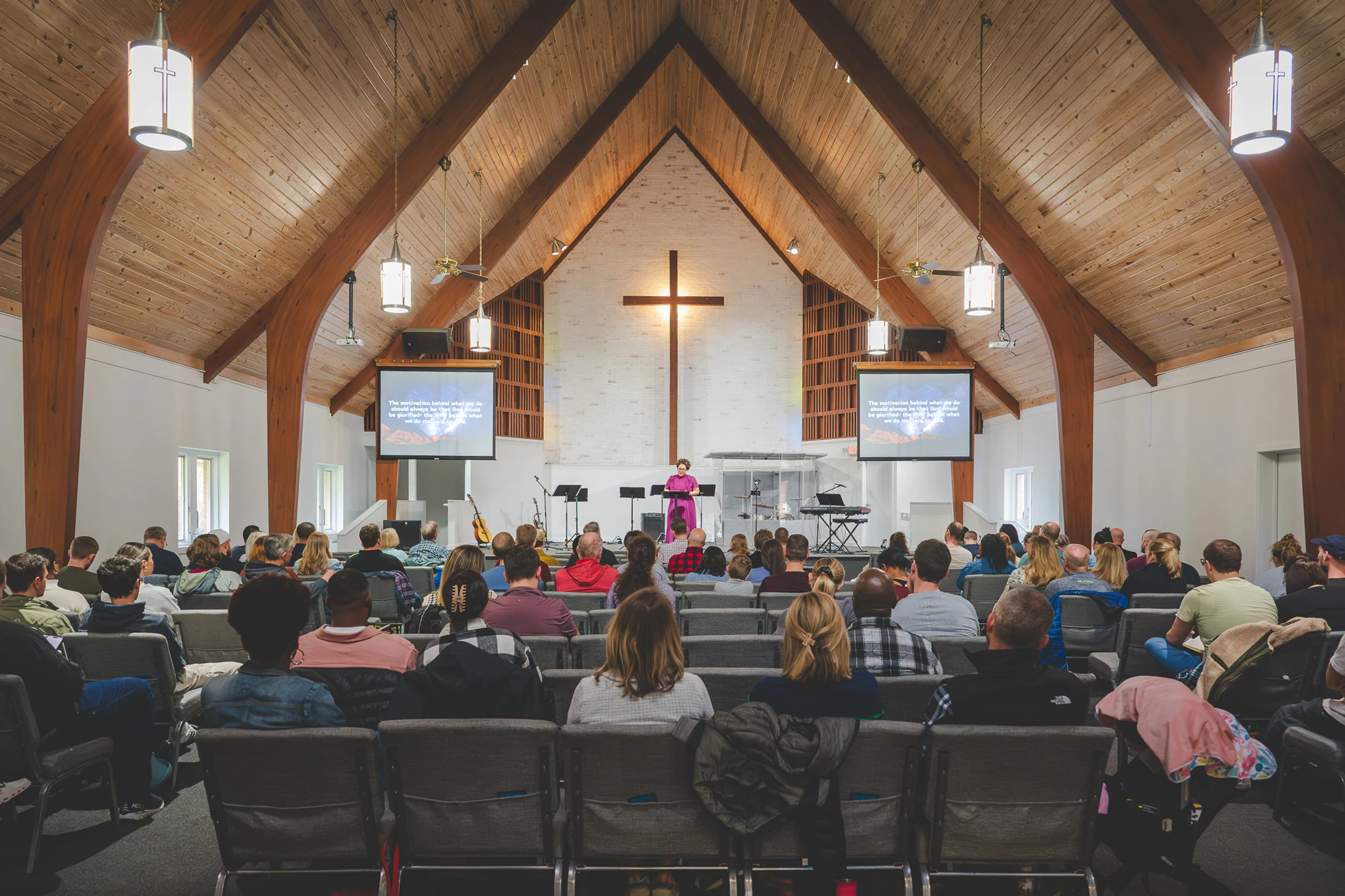
Join us this Sunday at 9 a.m. or 11 a.m. for our morning worship!

You finally got the promotion. The hunger remained. You finally got the affirmation. The insecurity returned. You finally bought the thing you'd been wanting your whole life. The satisfaction faded.
Sound familiar?
We are the most highly resourced, endlessly entertained, and accessibly connected generation in human history. And we are quietly, persistently, and insatiably hungry.
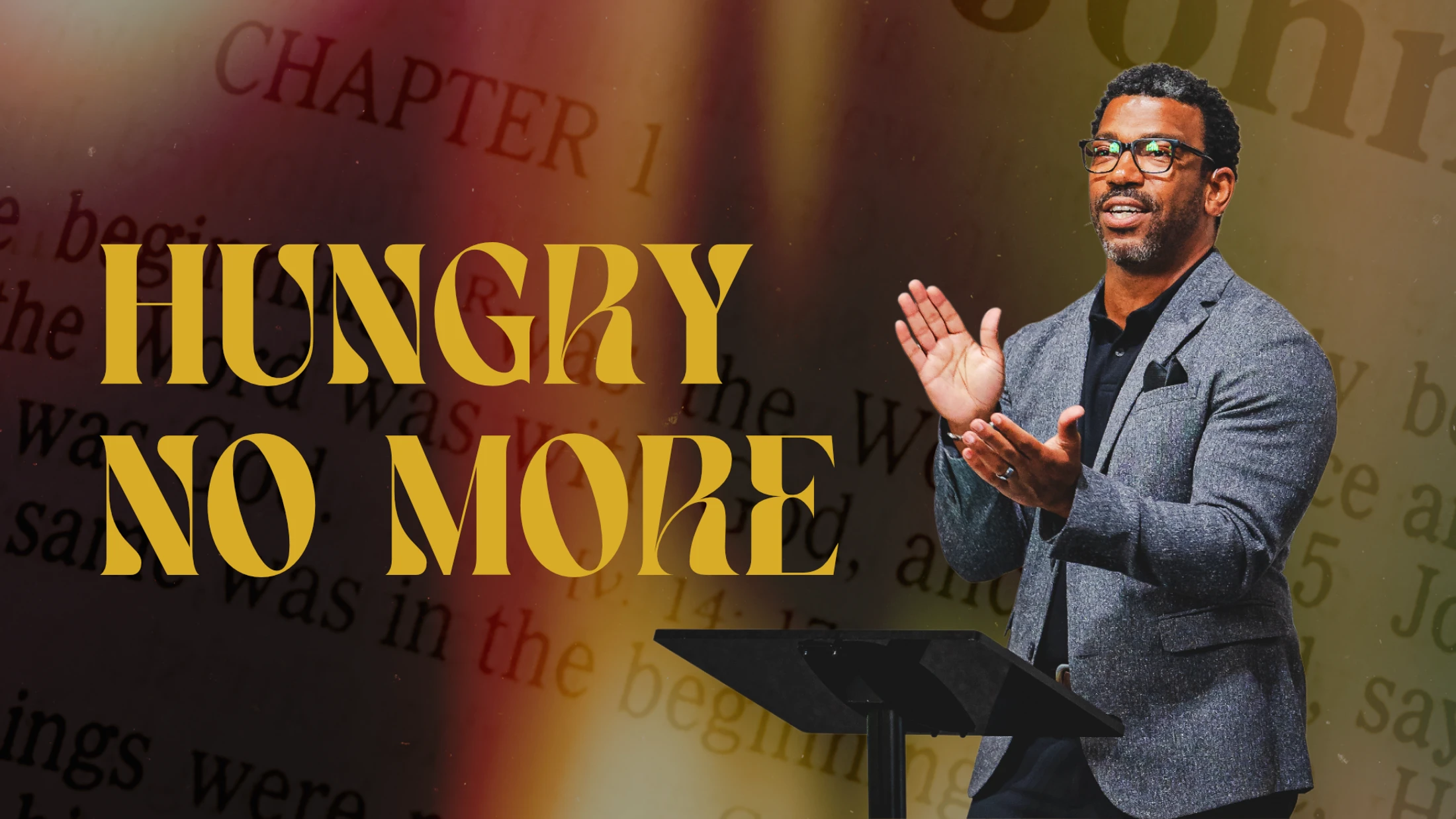
In this message, Pastor Rich Johnson takes us into the longest chapter in John's Gospel — and into one of the most confronting conversations Jesus ever had. The day after feeding 5,000 people with two fish and five loaves, the crowd came back looking for more. And Jesus looked at them and said something that stopped them cold: "You're looking for me — but not because you saw the signs. Because you had your fill."
They were hungry for bread. But they didn't understand what they were really hungry for.
Neither do we.
In this message you'll learn:
Whether you are exhausted from chasing things that keep leaving you empty, stuck in a checklist version of faith, or asking honest questions about what believing in Jesus actually does for real suffering — this message is for you. Because the door is still open. And whoever comes, Jesus says, he will never drive away.
📖 Scripture: John 6:25-51
Uh, the sermon, uh, today from the Gospel of John is found in chapter 6. It is the longest chapter in John's Gospel. I'm not going to read all of the verses, but it's a pretty foundational chunk of scripture. It's a foundational chunk of scripture because in it we find, like, where the gospel is and how John particularly is inviting people to live into this gospel story. The cost of discipleship, some— for some is very high, for others it feels quite comfortable and natural, but for all of us it is an invitation to come closer to Jesus. So I know that you just sat down, but I just like to see everybody standing one more time as we read the scripture together from John chapter 6, beginning in the middle, verse 25. Let's read together. When they found him on the other side of the lake, they asked him, "Rabbi, when did you get here?" Jesus answered, "Very truly I tell you, you are looking for me not because you saw the signs I performed, but because you ate the loaves and had your fill." Do not work for food that spoils, but for food that endures to eternal life, which the Son of Man will give you. For on him God the Father has placed his seal of approval. Then they asked him, what must we do to do the work God requires? Jesus answered, the work of God is this: to believe in the one he has sent. So they asked him, what sign then will you give that we may see it and believe you? This right after he performed a miracle. I just fed 5,000+ people with 2 fishes and 5 loaves, and still y'all, you people Let me continue. What sign then will they give you that we may see it and believe you?
What will you do?
Jesus answered, our ancestors ate the manna in the wilderness, as it is written, he gave them bread from heaven to eat. Jesus said to them, very truly I tell you, it is not Moses who has given you the bread from heaven, But it is my Father who gives you the true bread from heaven. For the bread of God is the bread that comes down from heaven and gives life to the world. Sir, they said, always give us this bread. Then Jesus declared, I am the bread of life. Whoever comes to me will never go hungry And whoever believes in me will never be thirsty. But as I told you, you have seen me and still you don't believe. All those the Father gives me will come to me, and whoever comes to me I will never drive away. This is the word of the Lord. The people said, thanks be to God. Let this word fill our mouths, fill our minds, flow from our mouths, and free our hearts to live. As beloved children of God. All right, give somebody a high five and tell them it's good to see you today. Yeah, y'all like giving high fives, huh? We should high five more often, I guess. Title of the sermon today is Hungry No More. Hungry No More. And John chapter 6 opens up with a miracle that everyone loves. We all love to read this miracle. It's Jesus feeding 5,000-plus. I say 5,000-plus because the record says that he fed 5,000 men because men were only counted in the census, and there were women and children there too. There was a lot of people, thousands of folks, and he fed them with the little lunch basket that one of the children had in the audience, in the crowd. Two fish, five loaves, and the miracle of multiplication began to fill everyone who was in the crowd to the point where people got to take home leftovers for free. Everybody's stomach was filled. The disciples are overwhelmed by this miracle. And by the time we get to verse 22, the excitement has shifted. The excitement that began in John 6 with Jesus performing the miracle has now shifted to— Ooh, yeah, that was a shift right there.
We okay?
Okay, sorry about that. The mood shifted just like that. One, from surprise to, "Is that gonna happen again?" The crowd woke up the next morning, came back to the same place, and was looking for Jesus to feed them again. But Jesus wasn't there. And by the time the sun reached its peak, they were wondering, "Is he gonna show up?
We need to go look for him." And they sent boats across the lake.
Crowds traveled from town to town looking for Jesus. And when they finally find him, he says something that is unsettling. He says, "You are looking for me, great, but not because you saw the signs I performed, but because you had your food and your fill." Your needs were met. In other words, Jesus is saying, "You search for me to feed you, but you don't understand the real hunger that you have." You don't understand what you're truly hungry for. You're hungry for getting your belly full, but you're really not hungry for the giver who feeds the belly. And this is our story too. In America, in these United States of America, we are the most highly resourced, endlessly entertained, and accessibly connected— I'mma switch to a hand mic. Okay, we're switching to hand mic. We don't have time to be doing all of that. No.
No. Let's see if I get this one. Hello? Okay. Alright. We're starting the sermon all over again. So in the Gospel of John. Now in America, we are the most highly resourced, endlessly entertained, and accessibly connected generation in human history. And at the same time, we are quietly, persistently, and insatiably hungry. We scroll endlessly. We chase achievements. We accumulate more and more things. We perform for approval. We numb ourselves with distraction. We work for exhaustion, or work ourselves into exhaustion. And the restlessness remains. The hunger underneath the hunger is still there. And scripture tells us that this hunger is is older than capitalism. It's older than technology. It's older than the 250 years of the American United States since its declaration of, quote unquote, independence. Because humanity has always searched for life apart from God. We have always searched for something that is life-giving. Ever since Eden onward, we have reached for created things. We have hoped that they would carry the weight of our ultimate meaning. And the problem is not merely just distraction, it is a disordered desire. There's a disordered desire inside of us where we want what cannot satisfy. King Solomon observed in the book of Ecclesiastes that earthly pleasures can never satisfy infinite longing. They are signs but they are not destinations. And every time we mistake the sign for the source, we wake up hungry again. We keep asking temporary bread to do eternal work. Will this temporary thing fix us? Will it change us? Will it satisfy us? Will it heal us? And it can only do so much because of its limitations. Which means John chapter 6, if you were to read it in its entirety, is not just about a misplaced appetite. It's about worship. Jesus is describing what real worship is to be like and who we are to satisfy what we worship. Because whatever we believe will save us, whatever we believe will sustain us, whatever we believe that will hold us is ultimately what we worship. What you believe is going to hold you together is what you worship. So some people worship achievement, some people worship certainty— I need to be sure— some people worship comfort, some people worship sex, some people worship nationalism, some people worship accumulation, some people worship approval. And in all of these worships, they leave us feeling empty the next day. They don't fully satisfy. And the human heart is always placing its full weight on something. You're gonna serve somebody. Don't know that song. Johnny Cash. And Jesus comes to confront the false altars we keep building with our lives. You're gonna serve somebody. You're gonna serve something. And some of these things are not bad things. They're very good things. But Jesus says, "You are looking, but you're never finding." And he doesn't scold them. Notice the grace and the mercy. He doesn't scold them. He doesn't say that the earthly bread doesn't matter at all. He says, "Just don't work for food that spoils, but for food that endures to eternal life." Don't put your hope on things temporal. Put your hope on things eternal that will live and last forever. Not just live and last forever in the next life, but will live and last forever in the right now in your heart. And the audience, you gotta consider the audience here in John 6. These are hungry Hebrews. And hungry people understand bread language differently than not hungry people. If you're not hungry, you don't really understand this passage. If you don't have anything craving, anything like, you know, that's driving, you don't really fully understand this passage. There's more to this. But hungry people, they hear this and they know. Israel heard that bread language and they were reminded, yes, there was a time when our people were enslaved. There was a time when we lived with lack and scarcity. There was a time when we wandered around the wilderness. It might have been our fault, but we were still wandering around in that wilderness way too long. They remembered, they remembered the story. When manna fell from heaven after generations of oppression in Egypt, they remembered the story of manna falling. And if they collected enough for the next day, it would spoil because God wanted them to depend on God for daily bread. That bread meant survival. That bread meant life. So when Jesus fed these 5,000 people in occupied Galilee, he's feeding people who are living under the Roman oppression of taxation. And instability and economic pressure. This was not abstract for them. This was very real. These were hungry people who weren't really sure when their next meal was going to be provided. These were hungry people who weren't really sure what kind of cost it would be to them if their meal was not provided. And yet, in fact, Jesus insists, amidst all of that truth, that even full stomachs cannot satisfy starving souls. A full stomach cannot satisfy a starving soul. They received the bread yesterday. Miracle. They woke up the next day hungry, reminding us that the limitation of earthly bread— no matter how much manna we gather, we will wake up hungry tomorrow if our identity is anchored in temporary things. If it is anchored in something that will ultimately fail you or depart from you, it is something that will not last. And finite things can never satisfy an infinite longing of our hearts. And some of us know exactly what that's like. We've been there before. You finally achieve the promotion and the hunger remains. You finally achieve the affirmation and the insecurity returns. You finally buy the thing that you've been wanting your whole life. Now that you're turning 50, you're finally going to get that car that you wanted. I'm speaking to myself right now. And the satisfaction fades. You finally get the relationship and you find that it's still a stress and a struggle and a work. You finally arrive at the goal and discover that it can't hold the weight of your soul. Beloved, we have been were there before. Some of us are there right now because finite things cannot satisfy infinite longing. So my question of reflection in my pause in the message right here is this: Where are you working for food that spoils? What is it that you are putting effort and energy into that is leaving you empty at the end of the day? What is driving that motivation to keep putting more and more into that area, in that space of life that ultimately is not leaving you more fulfilled? It's leaving you feeling empty. That is the question that John is inviting us to wrestle with in this text of John chapter 6, because The next place he goes to, when the crowd responds to Jesus, also points to our inward hunger. The crowd responds, 'What must we do to do the works that God requires?' What must we do? What must we do? What must we do? It's an honest question. But it's a misguided one. Because in short, they're asking this: What's the checklist? What is the program that we have to attend? What is the step? And if you could please give us all 8 steps at one time, not just one at a time. Tell us what to accomplish so that we will know we have reached The end. What must we do to do the works of God? And why do we consistently respond like this? Why do we consistently respond with wanting the checklists and the steps? Because I think it feels safer to do than it is to trust. It is safer to mark things off the checklist because that helps us feel like we're in control. It helps us to feel like we've accomplished something. Can I be honest with you? One of the things I enjoy about pastoring is the time when I'm not pastoring. Like, to actually do yard work and cut the grass and look back and say, "It's done. Praise God, it's done. I did my thing today." You know what I'm saying? It's all good. There is some finality to checking things off the list. Rather than being constantly in a cycle of dependence on God for, "Lord, how do I navigate this? How do I respond? How do I live into the tension of the right now?" I love the checklist because it makes me feel like I'm done. And following Jesus sometimes don't ever feel like you done. It don't ever feel like you done. You constantly being worked on. You constantly being shaped. You constantly being in the fire. You constantly being refined. I'm like, "Lord Jesus, take me now." Seriously. But not seriously. I still gotta see all my kids graduate, you know what I'm saying? But we get into that place in our formation where it's easier to mark things off the checklist rather than it is to trust. And Jesus disrupts this religious economy that we have all— all of us have bought into. The work of God is this, beloved, to believe. Believe in the one that the Father has sent. That was the hardest thing you could have asked them to do. What do we got to do to do the works of God? Believe. All right, but what else? Trust. Oh, okay, okay, okay, okay, I'm taking notes. What else? Believe, trust, rely. All right, all right, all right. These are things I can't quite check off here, uh, Jesus. Believe, trust, rely— that, that kind of is ongoing. And this is where the Greek helps us out in this passage. Believe is the word pistio, pistio, and it does not mean intellectual agreement. It means signing a statement of faith in John's Gospel. Throughout his Gospel, and he uses this word the theologians say. I haven't actually counted all of them, but they said 99 times. 99 times John uses this word to mean trust, to rely upon, and to put your full weight onto someone. And it went on to say the, the way that you step onto ice, you're not quite sure, is this going to hold me up? That trust that you step and move. One scholar said it's trust that moves your feet. Or what James says, it is faith in action. It is belief that— that movement that follows belief. To believe is to act, but it's not like checking off a list. It's not passing some belief test even. It is falling into the arms, the grace of God, and that is harder than a checklist. A checklist allows me to remain in charge. A checklist allows me to say, "I did that thing. I cut the grass. I edged it and it looks sharp." But I didn't make the grass grow. I didn't create the circumstances that allowed the grass to become thicker. No, this is the work of God. And so rather than perform our way into a relationship with God, Jesus invites us to the presence of God that is already with us. God is already with us. And some of us would rather impress Jesus than lean on Jesus. Jesus, look what I did today. Jesus, look at what I did today. I responded. But rather than performing for Jesus, doing for Jesus, he invites us to lean on him. And now the crowd is like, okay. Okay, I get what you're saying, because Exodus 16, it said that manna fell from heaven, and Psalm 78 says that this manna is the grain of heaven. But, but I'm still, I'm still unsure, Jesus, what does this mean? Because Moses, Moses gave us that manna. Moses gave us that bread. And Jesus replies, 'It is not Moses who gave you the bread. It was my Father. And the bread came down from heaven, and it gives life to the whole world.' And then he responds with a shock, 'I am that bread. I'm the manna. And whoever comes to me will never go hungry. Whoever believes in me will never be thirsty.' Harkening back to John chapter 4 and his encounter with the woman at the well. He says, "I am the bread of life." I am the source. He didn't say, "I came to deliver bread to you." And some people who see Jesus as a deliverer of some good news, some good way. He didn't say, "I come to make sure that the bread is evenly distributed." This is not a social work project. He didn't say, "I come to point you in the right direction." He's not just a prophet. He says, "I am the bread." In John's Gospel, particularly John chapter 6, God has become edible. He became real and tangible. Father, Son, Spirit, all poured into this humanly body, had taken on flesh and blood. It entered history. And it stands now in front of a hungry crowd and it says, "I'm the answer." to what you have been searching for. And when you read the entire chapter of John chapter 6, it confuses people because then he says, you got to eat my flesh and you got to drink my blood. And they look to each other and they said, is this guy some kind of a cannibal? He has really lost his mind. And then John tells us, the 5,000 who were gathered there together all left. Showing that they were hungry, but they weren't ready to be satisfied. They wanted more of what they could control, not any more of what they couldn't control. And Jesus invited them to a life of surrender. Eat my flesh, drink my blood. And then the only folks who are remaining are those disciples, and Jesus turns to the disciples and he says, So are you guys gonna leave too? Are you gonna leave just like these thousands of others have left? And Peter, we know Peter, opened up his mouth. Lord, wherever shall we go? You have the words of life. Oh, you're so impressive, Peter, with your flattery. And Jesus responds to him, yeah, uh, the flesh I did not reveal this to you, but the Father revealed it to you and drew you to me. But I was coming for you before you were coming for me. And one of y'all— John elevates this— one of y'all is going to betray me. And he doesn't even answer who. They start, well, who is it, Jesus? It ain't gonna be me. I checked up everything off the list. And they start looking around at each other. And he never satisfies the answer to that question, which I think in John chapter 6 leaves us all— it leaves us all to ask ourselves, am I just looking for Jesus to check things off a list, or am I looking for Jesus? Am I looking for what Jesus can provide, or am I looking for the presence of Jesus? This crowd expected provision, but what they received was God's presence. Rowan Williams puts it this way, he's a theologian, he says, Jesus is not merely information about God, he is the place where God happens. Not a signpost pointing toward the divine, not a teacher transmitting wisdom from a distance, he is the place, he is the presence, he is the very bread itself. He is it. That's why I love Jesus. That's why no matter, for me, like what's happening in the world, Jesus is unmovable. No matter what's happening in my discomfort, Jesus is unmovable. No matter what's happening in the church, Jesus is unmovable. Because he is it. He's not just the one pointing to it. He's not just the one describing it. He is it. Manna, he says, will sustain your body temporarily. The reality is the achievement The approval, the things, the stuff, the people, they will satisfy you temporarily. But not forever. Only Jesus can sustain your soul right now. And this is the theological center of John's Gospel. That Jesus is not just a prophet, he is the very presence of God. And here, he reminds us that Jesus is going to say these 7 declarations. I am the bread. I am the light. I am the gate. I am the shepherd. I am the resurrection. I am the way. I am the vine. And each of those responses is declaring a different human hunger that can only be satisfied in Jesus. Each of them. So here's when I was reading this, I was like, okay, okay, this is, this is good. This is great news. But here's my question. If I'm— you ever read the Bible and you start dialoguing with the author? No, that's what you should do. This is what you should do. If you want to develop a spiritual practice of reading scripture, don't just read it, dialogue with it. Dia— ask the author some questions. Ask the author some questions. So I asked the author some— this question: what does believing in Jesus actually do for tangible suffering? Like, I'm really hungry. He says, believe in me, but I'm really struggling. What does that really, what does that really do? Anybody ask that question before? I asked the question, what about injustice? I asked the question about poverty. I asked the question about shelter. I asked the question about grief. I asked the question about systems that crush human dignity. I asked the question, the question over and over again. And it is a fair question. Can I get any witnesses in here that have some questions? Lord, believe, but what is it gonna mean? And here's what the text doesn't permit us to say, though: that Jesus only offers spiritual satisfaction while the material world stays broken. He doesn't say, 'Do this spiritual thing and ignore this material thing that's not happening over here.' Why? Because he fed 5,000+ people. He did not wave away their hunger. He will perform miracles after this where he meets practical needs. And so while hungry people understand bread language, Jesus still chooses to use bread language to say that the bread of life, Jesus, to feast on him is not to escape from this physical world, is to be sustained in this physical world. In this life, he tells them, you will have trouble, but be encouraged, I have already overcome the world. I have already come the destruction. I have already come the denial. I have already come the depression. I have already overcome it. And the deepest source of satisfaction that we can find in this material, broken, physical world is Jesus. That to believe in Jesus does not make injustice disappear, but it plants in us a life that refuses to accept injustice as the final word. It births inside of us a refusal to accept that everybody can't be fed because there's enough food on this planet. It refuses us to allow to accept that darkness will reign when I see beauty all around me. It refuses to accept that, that we are unredeemable people when we have seen God redeem people in situations and circumstances and even places over and over again. When we feel dry, Jesus saturates us with the rain of the Holy Spirit. It's Pentecost today. And believing in Jesus ought to make us more concerned about when we see the disconnect between heaven and earth. When we see it not happening on earth, that ought to cause a disruption in our souls. And where there is no disruption, I have to wonder if you're hungering for things that are temporary and not things that are eternal. Because Jesus told his disciples to pray this way. Let your will be done on earth as it is already being done in heaven. And I'm not waiting for heaven to experience God's eternity. I want God's eternity right now. I wanna be transformed right now. I wanna see people transformed right now. I wanna see systems and structures transformed right now. Miroslav Volf, a theologian of reconciliation, says that Christ came to transform us from never enough people to more than enough people. That through his poverty, we might become rich. He has come to transform us from people who think in a scarcity mindset, in a poverty mindset, to people who will think, live, and act in an abundant mindset. My needs are met. All of my needs are met in Christ Jesus. And in Christ Jesus, I pray that heaven come down to earth. Let's work together for that. Let's work together to feast on Jesus until more people are hungry for the things that Jesus is hungry for. The transformation of lives. The transformations of systems and structures. The transformations of governments in the name of Jesus, not by manipulation but by loving kindness. This is what Jesus says: Y'all see me and y'all still out here asking for a sign. What else Jesus got to do? What else does Jesus have to do? And the reason they ask for a sign again is because they only look for what they can get from Jesus for themselves and not what Jesus is doing in the world. Can I expand your kingdom mindset and imagination for a moment? We tend to look so myopic at our own situations that we ignore what God is doing in the lives of others. We get so fixed on our situation that we can't see that God is doing work outside of ourselves. And so we say, woe is me. We say, nobody knows the trouble I see. Nobody knows but Jesus. And Jesus knows and shows up because underneath the hunger for temporary things is the hunger for something eternal that Jesus can satisfy. This is why he says, whoever comes 'Whoever comes to me, whoever comes to me, I'll never drive them away.' That's the invitation for us this morning, is that as we are on the journey naming the stuff that we're hungry for that can't satisfy, he still says with open arms, 'Come to me, I will never drive you away.' I'm not going to drive away the person who thinks they have perfect theology or imperfect theology. I'm not going to drive away the person who has cleaned themselves up and still got work to do, and the person who's unclean and is on their first step. I'm not going to turn away the person who thinks they got all the answers and the person who thinks they don't know nothing from nothing. I'm not going to turn away the person who believes they made all the right turns or the person who made all the left ones. I am not going to turn anyone away. And Jesus' invitation is this: Will you open yourself to what Jesus has already opened himself to you? The arc of this passage is not complicated. We are hungry. We try to satisfy ourselves with temporary bread. We exhaust ourselves trying to earn what cannot be earned. And then we encounter the one, the one who does not merely give life but is life. And the door remains open. Whoever comes to me, I will never drive away. And one of the things we don't do often here at Sanctuary is we don't often give like an in— what they call in my Baptist upbringing is an invitation to discipleship. The invitation to say yes to Jesus who's already said yes to you. Part of that, part of the reason we don't do that Often is because the majority of people who are coming to Sanctuary are already believers. You're already on that faith journey. You might be, uh, somewhere on your faith journey where you hit a wall and things are hard for you. You're not quite sure how to make it through the wall. You might be in a stage where you're deconstructing. You might be in a stage where you're frustrated. You might be in a stage where you were just looking for a good church, you know, with some good people. There, there are believers and we love believers. Because I'm concerned that we look more like Jesus. And we need to look more like Jesus. But then there's other times where we need to invite somebody to make a decision. I invite you to make a decision. Today may be your first day on that journey. And there aren't any promises that the journey is going to be easy. In fact, the promise is that the journey is going to be challenging. But while the journey is challenging, there is joy in the midst of it, because as long as you got Jesus— the scripture says the joy of the Lord is my strength. My strength is not built on nothing less but Jesus' blood and his righteousness. Those are the old, old hymn folks that know what we're talking about. And so if that's you, we invite you to make that decision, that determination today to choose to say yes to Jesus, who's already said yes to you. And if you are a believer, you've already been on that journey, I invite you to say yes again. I invite you to say yes again. Yes to depending on Jesus. Yes to trusting in Jesus. Yes to relying and leaning heavily on Jesus in any area where you are relying and leaning on yourself. I invite you to say yes to Jesus as well. Let's pray. Dear Heavenly, most gracious Lord and Savior, we thank you. We thank you for Jesus. We thank you for Jesus who fed practical needs, hunger, thirst. He provided for it. He didn't ignore it. Thank you that Jesus cares and is concerned about our everyday lives. There are people here this morning, right now, who have real practical needs. Someone is looking for a job. Someone is looking for healing. Someone is looking for restoration. Someone is looking for companionship. And Jesus, you meet real needs. And you also invite us to be satisfied by the provision that supersedes all of those needs. In Jesus Christ. So Lord, where there are ones here taking their first step, we rejoice and say hallelujah. Thank you, God, for taking that first step. And for those who are taking the next step, Holy Spirit, we thank you for meeting us right where we are. In the strong name of Jesus, we do pray.
Amen.
Join us this Sunday at 9 a.m. or 11 a.m. for our morning worship!