
We can't wait to see you
Join us this Sunday at 9 a.m. or 11 a.m. for our morning worship!

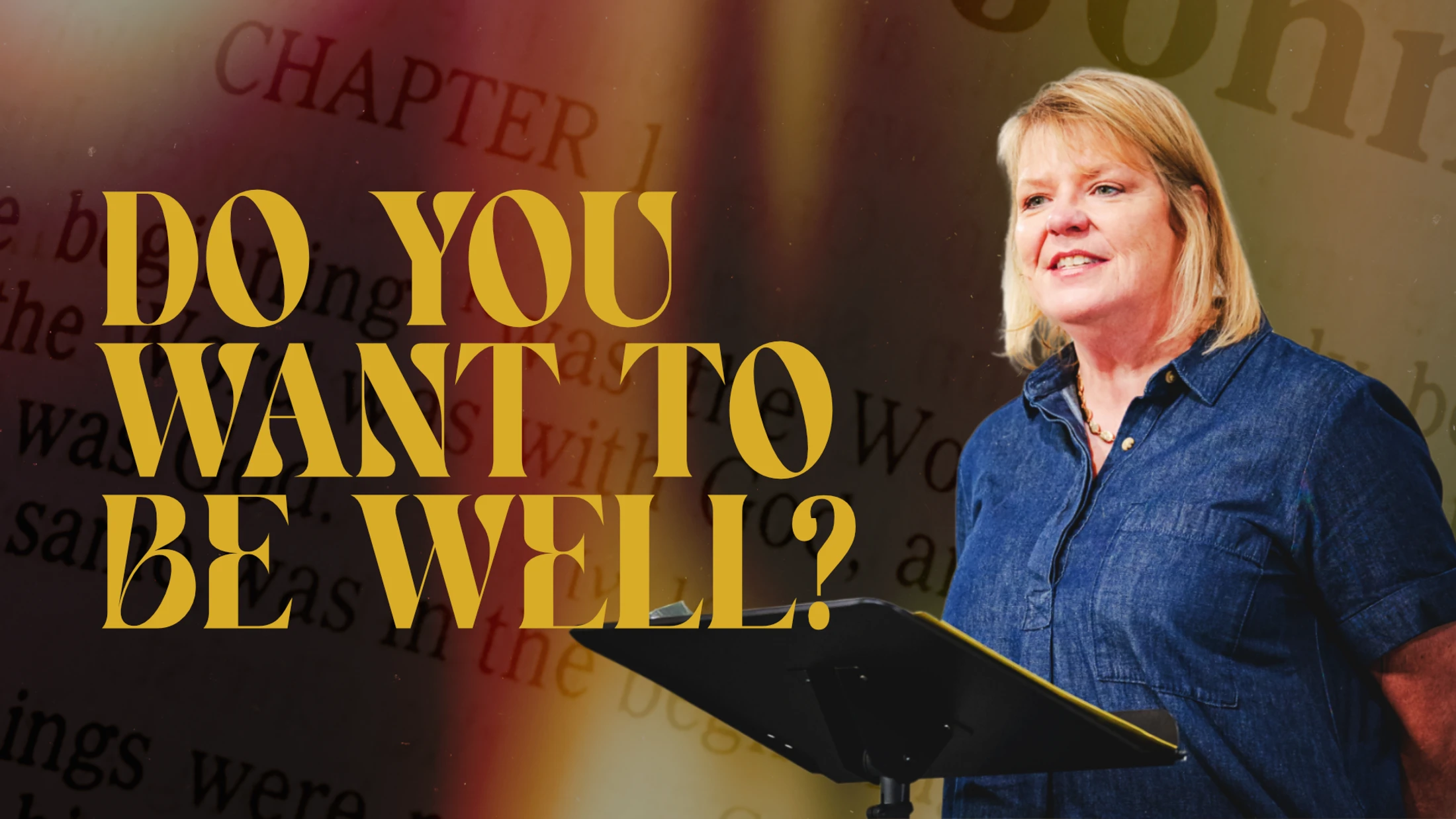
Guest Speaker: Nancy Dumford
A broken princess wand. A little girl's tears. And a grandmother with a hot glue gun doing her best to hold it all together.
Sound familiar?
Because if we're honest, most of us spend more time hot-gluing our lives back together than we do actually pursuing wholeness. We cope. We manage. We keep the game of pretend going. Until Jesus shows up and asks the most disruptive, most personal, most hopeful question in all of Scripture: Do you want to be well?
In this message, Nancy Dumford takes us through two powerful healing stories in the Gospel of John — a royal official whose son is dying and a man who has been lying beside a healing pool for 38 years — and draws out three movements that are as relevant today as they were then.
In this message you'll learn:
Whether you are lying beside the pool with a familiar story of why you're stuck, or you're in the middle of a transition that has you doubting everything, this message is an invitation to stop hot-gluing your life back together and say yes to the journey of wholeness Jesus is offering.
📖 Scripture: John 4:46-54 | John 5:1-9
Since I have been here, I have a granddaughter now, Noah Rose. And Noah is recently very into princesses, which is unfortunate because I'm not such a fan. And I keep telling her, "Nana doesn't really like princesses," but I support her love. So the collection of princess dresses and accessories keep growing, the tiaras, and the glitter and the sparkly things around. And Noah has this perfect magic wand with a big purple jewel in the middle of it. It's a whole thing. And well, last week she was at my house and the purple princess wand broke. Obviously she was trying to get it to do its magic purpose and whatever she was determined to bless snapped the top of the wand off. Whoops. And it created this reaction of shock and upset and surprise and tears and dismay. And she handed it to me and said, "Nana, fix it," which is honestly part of the job of being a good grandparent. So I got busy. What kind of solution could I find? No super glue. That would've been the move. But instead I went down the basement and came up with the second best thing, hot glue gun. I'm trying to get it together, and honestly, it held it on. It worked sort of. Then we had to add a little Scotch tape after that. The hot glue gun held the piece on mostly, but it wasn't really whole. It was fragile. You had to be careful with it. If you look closely, you cannot miss the globs of glue and the tape. It wasn't perfect. And of course it wasn't long before it broke again. And so it was sent home with me to fix this time, but I'm a good nana, so I came up with a new one. Amazon, $7.99 in Cinderella blue, brand new. And that is when I saw the spiritual metaphor. Our lives are like a princess wand, beholding magic, and sometimes they snap apart or piece breaks off, and then we spend a lot of time and effort trying to hot glue it back together, hot glue ourselves back together. Once it is patched up, we try to cope and manage so that the game pretend princess can continue, but the glue won't hold. And there's a world of difference between holding something together and being made whole. I wonder if that's what Jesus perceives in John 5, where he looks at the man lying beside the pool year upon year and asks, "Do you want to be well?" It's a question of longing and desire. Jesus is asking something below the surface. Do you want quick relief or do you want to be made whole? Right before the healing at the pool, John tells another story of healing. 2 stories, they go together this morning. So let's start with the one from John 4:46. Hear the word of the Lord. Once before he visited Cana in Galilee, where he had turned the water into wine, and there was a certain royal official whose son lay sick in Capernaum. When this man heard that Jesus had arrived in Galilee from Judea, He went to him and begged him to come and heal his son, who was close to death. "Unless you people see signs and wonders," Jesus told him, "you," you all, it's plural, "will never believe." The royal official said, "Sir, come down before my child dies." "Go," Jesus replied, "your son will live." The man took Jesus at his word and departed. While he was still on the way, his servant met him with the news that this boy was living. When he inquired as to the time when his son got better, they said to him, "Yesterday at 1 in the afternoon the fever left him." Then the father realized that this was the exact time at which Jesus had said to him, "Your son will live." And so his whole— he and his whole household believed. This was the second sign Jesus performed after coming from Judea to Galilee. This is the word of the Lord for the people of God. And the people said, thanks be to God. The Gospel of John is so delightful. It's so unique from the first three Gospels. It's the fourth one and it's the last one written. And though I can't prove it, I imagine John the Apostle having this "oh crap" moment. The first-century followers expected Jesus to return in their lifetime. So here is John, the disciple who outlived the rest. He's advancing in age and reading the other three Gospels. He must have decided that he had something important that must be added. I mean, Jesus called him one of the sons of thunder, and so he's a character, and you might know some of the stuff that he pulled. He never mentions himself by name in his book. He says— he calls himself the disciple whom Jesus loved. Talk about being secure in your belovedness. We should all be like him. And he often— he also spills some tea. In the Garden of Gethsemane, before Jesus is arrested, remember there's all that stuff that happens, the ear gets cut off. And in all three of the other Gospels, they use this vague language: one of them struck the servant. Not John. He goes right in, drops the name. He says this: Then Simon Peter, who had a sword, drew it and struck the high priest's servant, cutting off his ear. He then goes on to mention the servant Malchus. And then in writing about the empty tomb, you remember this, John describes how he and Peter run to the tomb, but then he adds who got there first. So for all time's sake, the fact that he won the track race is in the scriptures. His whole purpose in writing is declared in verse 20, that you may believe that Jesus is the Messiah and the Son of God, and by believing you may have life. In his name. He does some stuff really well. He gives us the I am statements: I am the bread of life, I am the Good Shepherd, I am the door. And then he includes 7 signs to persuade readers to believe. It invites us to wonder, who is this man who can do all things? How can he be the master of quality and distance and time and quantity and natural laws and misfortune and even death? Each sign reveals a unique quality that only God could possess. And the story kind of envelopes— it starts out, once more he visited Cana. In Galilee where he had turned the water into wine. It's calling back. And then it ends by declaring the importance of what just happened. This is the second sign Jesus performed. As it turns out, the miracle of water to wine was the first sign, and the healing of the official's son was the second sign. Both events happened in Cana. And in the first recorded miracle, Jesus attends a wedding where the wine runs out. He turns gallons of wine— water into wine, but it's not ordinary wine. It's the good stuff. Who is this winemaker without a vineyard who could produce the highest quality wine? Now, in the second sign, Jesus heals a boy. Without even being there. From a single conversation with his father in Cana, the boy gets better. Who is this master of distance who does not even need to be present for power to work? Indeed, the Messiah is master of both quality and distance. He grants both requests in unexpected ways, demonstrating God's love of humanity and flourishing and joy. The party continues because of the wine. The boy's son recovers, and all who are aware of it see Jesus for who he is— a miracle worker over quality and distance. Got one more story. I might have been concerned that I was given 30-some verses to cover. The second story is it is also about healing, and it is considered the third sign. So you get 3 of the 7 in one week. Jesus meets a disabled man waiting near a healing pool. Let's hear the words from Luke 5. One who was there had been an invalid for 38 years. When Jesus saw him lying there and learned that he had been in this condition for a long time, He asked him, "Do you want to get well?" "Sir," the invalid replied, "I have no one to help me get into the pool where the water is stirred. While I am trying to get in, someone else goes in down ahead of me." Then Jesus said to him, "Get up, pick up your mat, and walk." At once the man was cured. He picked up his mat and walked. The miracle reveals how Jesus is the Lord over time. Over and over, the man has tried to enter the pool for just a little relief. He never makes it in the water in time because someone else enters more quickly. He's not in time, and he has been trying for a long time. Even the day was not the right time. It was the Sabbath, and on the Sabbath both healing and mat carrying were forbidden. And then Jesus enters the scene with his own sense of time. He asks a probing question that may even sound a little bit of offense. It's been 38 years. Long enough to get quite comfortable and familiar with the suffering, long enough to be settled in disappointment, long enough for everyone to give up an expectation of change. And after 38 years, the man may have given up. Of course he wants to be well, but instead of answering yes, The man explains the system. I have no one to put me in the pool. Someone always gets there before me. But Jesus is not bound by the system or by time. He brings the man more than relief. He brings a cure. Take heart. Jesus has something good for us today. And I want to frame these two stories around three points. That Jesus invites our desires, that wellness requires participation, and that healing becomes a sign to others. So let's begin with the invitation, Jesus's question about desire. Do you wanna be well? Depending on your story, there are many ways that you can hear that question. It may sound hopeful or exhausting or offensive or impossible. I would invite you to hear it today as an invitation to name your desire before God. What is the deep need that remains present in your life? What is the longing beneath the surface that you do all— spend all your time coping and managing. Now, for some of you, the desire is physical: healing from a disease, relief from pain, energy from a tired body, rest after too many sleepless nights. For others, the need is emotional and mental: for peace, for freedom from anxiety, from freedom from depressive depression, Knowing what to say, the voices that keep reporting the weather in your head, for freedom of thought. For others, the ache is relational: a family fracture, loneliness, longing to belong, a distance that just always seems to remain. Or perhaps your need is connected to circumstance: work, finances, uncertainty, your home life, or thoughts about the future. Jesus asks, "Do you want to be well?" And the answer requires vulnerability. We believe that Jesus can do anything, so the bravest thing may simply be to say out loud what you want. Sometimes we avoid naming our desire to avoid experiencing the ache that it brings. And I wanna say this carefully, pastorally, these healing stories are not simple formulas. Jesus healed the official's son. Jesus healed the man at the pool. And yes, Jesus still heals today. But healing does not always unfold the way we expect or want. Or in the timeline that we would choose. And there are times when fervent prayer does not bring full healing, and there are ailments where the cure has not yet been discovered, even as our life expectancy year upon year continues to rise. This reality can make healing stories difficult to hear, and yet God never moves from our side. God dwells near and loves well and accompanies us through each one of life's trials. And sometimes wellness looks like strength for another day, the grace to keep going, being present in the good that is here right now. It is strength to keep going and courage to face what is before us. And that's why the care of a faith community is so critical in times of need. This is why we take time to reach out and to be the hands and feet of Jesus to those around us. We do not control aging or illness or loss. They're out of our control, or the fragility of being human. Yet even in the middle of extreme hardship, God works. Jesus is always working deeper than, than symptom management, which leads to the second movement of our story: wellness requires participation. The man said, "I have no one to pull me in the pool. Somebody always gets in before me." After 38 years, that response makes perfect sense. Disappointment can train us to speak the language of limitation and not hope. We have become experts in our stuckness. This is why I'm stuck. But Jesus is not bound by the system nor the time. So instead of helping the man into the water, Jesus directs him to something entirely different. Pick up your mat and walk. Grace is free. Healing is a gift. But transformation will ask something of us. Somewhere in the healing process, we begin partnering with Jesus in our own becoming. And I've been thinking about this a lot lately. A week ago on Friday was the first day that I truly did not go to work at the church where I had just finished serving. It was the first day of my new reality. Late in the afternoon, my husband Brian called and opened with a word like he does, "So, did you spend the day as an unemployed lounge lizard?" You can laugh, it made me laugh. Seems slightly rude, but it was a sign of how well he knows me because transitions are hard for me. Every time I leave a church, every time I leave for vacation, there is this old pathway in my brain that lights up immediately. And I start to think dark thoughts. Maybe your best work is behind you. Maybe there won't be another meaningful chapter. Maybe you won't have enough to succeed in a new context. Maybe you will remain unemployed. Uncalled. Suddenly I can feel myself emotionally sitting down beside the pool. It's like I lose my sense of self and I doubt my identity. Who am I apart from work? I see you Enneagram 3s out there. I know it's going to happen, yet I feel unable to change my emotional response to change and transition. There must be something strangely comforting about this pattern of thinking that is predictable and familiar to me because I keep doing it. Having done 3 times before, 3 other times I've left interims to be waiting for the next thing, I gave some thought as to what was coming and I thought, I want to do this moment differently. I wanna go in a different neuropath direction. So last Sunday I attended Sanctuary. You might not have seen me, it was at the 9:00 AM. And it allowed me to remember and to reconnect with my early roots of becoming a pastor. And then on Monday, I got in my car and I drove up to Fredericksburg Presbyterian Church, where Amish buggies roam the streets. And I connected with that congregation that had been super important to me for about a year and a half. And as I did both of those things, I listened for the wind of the Spirit to blow my way. I took in nudges and I received love and I gained perspective and I began to sense healing and change in my pattern. And as a way of simply saying to Jesus, "Yes, I want to be well." Now I tell the story, I've got to like basically give you a confession of cheating because I knew the topic that I would be preaching today. And so on my tour of the congregations, that was on my mind. What does it look like to be well in this this moment. So never doubt my overachiever neuropathway. That can be a whole nother sermon, another journey. I want to do what wellness requires, and in this case, it required release, letting go of an old identity, taking responsibility for my thoughts, and trusting the God who has never failed me yet. So Jesus, when he heals this man, he tells him to rise and walk, and that human— and that healing becomes a sign for others. So the final movement is that healing becomes a sign for others, that these miracles are not magic tricks. These are signs that are pointing us to Jesus, and the signs open the door to believe Jesus. The royal official believes. The lame man by the pool believes. Their households believe. People begin to see Jesus differently because healing has entered the story. And that still happens to us now. Our journey with Jesus impacts the people around us, which makes wellness and healing a communal experience. When a church family member weathers the worst storm and then rallies to bring support, comes from the church, we all see and experience a greater appreciation for the work of God in hard, desperate places. Hope becomes visible, peace becomes visible, resilience becomes practice, and trust grows. Your story becomes a sign that someone else can survive and carry on and rebuild again because they have seen it in your life. We go stronger in trusting God out of our need and out of our brokenness. And we do not need to hide our trouble and pain. Faith is designed to be a communal practice, and the power of God is at work in you, and that inspires me, and I tell some of my story to you, and I inspire you, and God God uses it all. And I have one little nuance to this. Henri Nouwen, in his beautiful book, Life of the Beloved, writes about how we can experience our brokenness in two distinct ways. We can experience that brokenness interpreting our lives through the lens of the curse. Think Genesis 1. Being abandoned. And forgotten and alone. Or we can place our brokenness under what is true. Before we were ever broken, this was true: we were chosen by God and blessed and beloved by God. Before anything broken happened, we were beloved. And that allows us to experience that brokenness in a whole different way. Before the wand snapped in half, it was beautiful. And maybe that is the good news that I want to leave you with today. God is not asking you to hot glue your gun, your life back together. Now pull this out here, the bad one. Nor is he asking you to settle for a game of pretend princess portraying that you are whole all the while you're aching inside. Jesus is inviting you to a journey of transformation rooted in relationship with God and laying hold of love and compassion that leads to a greater experience of wholeness and shalom. When God whispers, "What do you— do you want to be well?" I hope that your answer is yes. Because life does not end by the side of the pool. Wholeness takes shape as you begin to rise, as we stop avoiding our broken places and stop defining ourselves by these familiar patterns. Let us instead be more fully— trust more fully in the one who is master over quality and distance and time. And the other four signs, the one who is master over quantity and natural laws, misfortune and death. May we believe and belong to the one who continually knows how to make all things new. And honestly, I like the blue wand better. Amen. Join me for a word of prayer. Lord, we breathe a breath in deep and long. Spirit, you are the very breath within us. You go before us, you go behind us, you hem us in, and you dwell within us. And so, Lord, it's my prayer that some here today would have the courage to name before you an unnamed desire, a longing, a way that they seek your wellness. Lord, would you lead us to partner with you towards wholeness? Would you remind us of what divine love does for us? May we know your compassion, the kindness in your eyes, the comfort of companionship, and the trust that you will work it out because you are faithful and you have always been faithful and forever faithful you will be. And so we trust you with the hard and the broken. And we say, Lord, fix it. Show us where to stand, where to walk, and how to carry that mat. Thank you, Lord. In the name of the Father and the Son and the Holy Spirit, I pray. Amen.
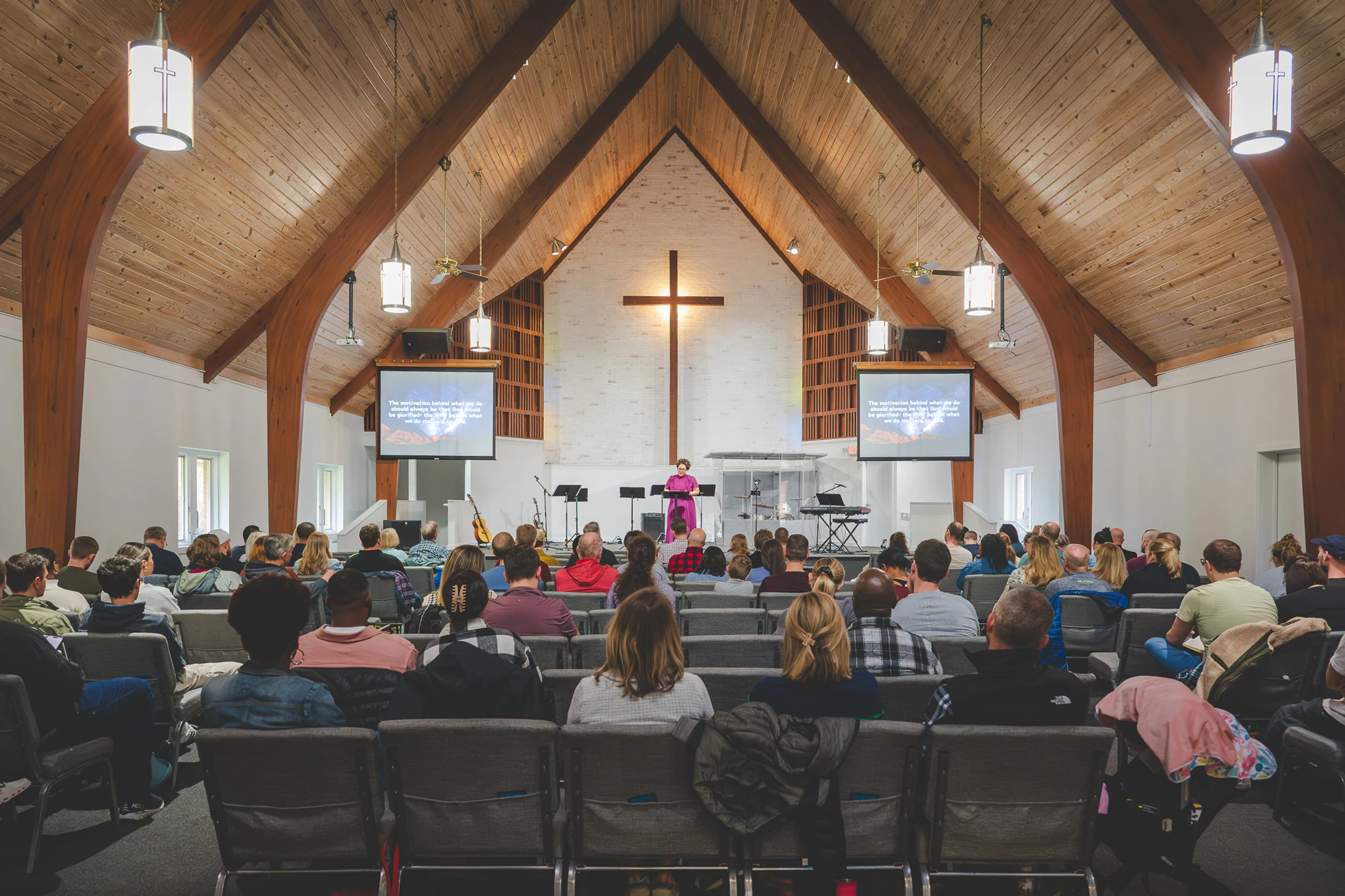
Join us this Sunday at 9 a.m. or 11 a.m. for our morning worship!