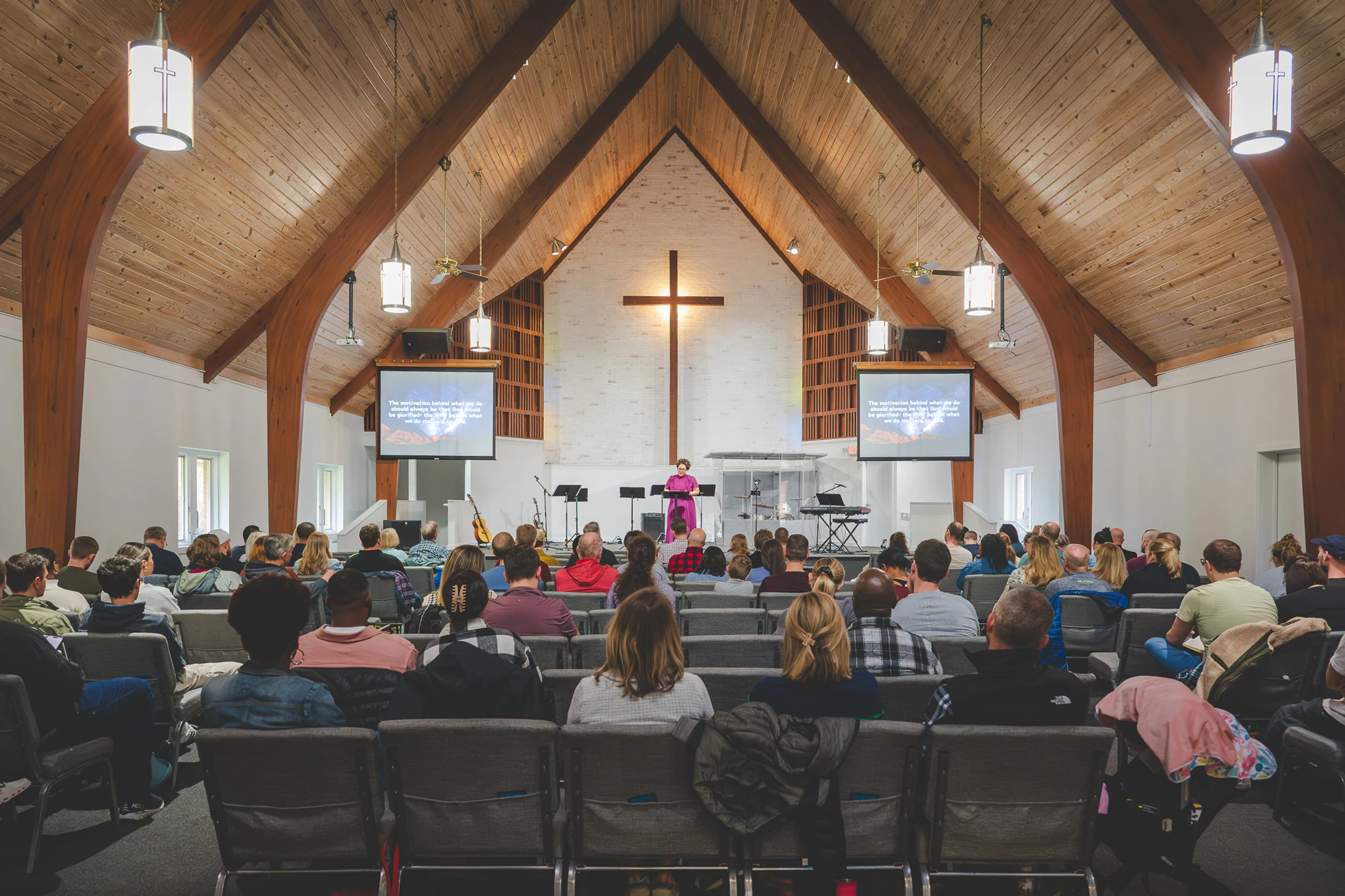
We can't wait to see you
Join us this Sunday at 10:00 a.m. for our morning worship!

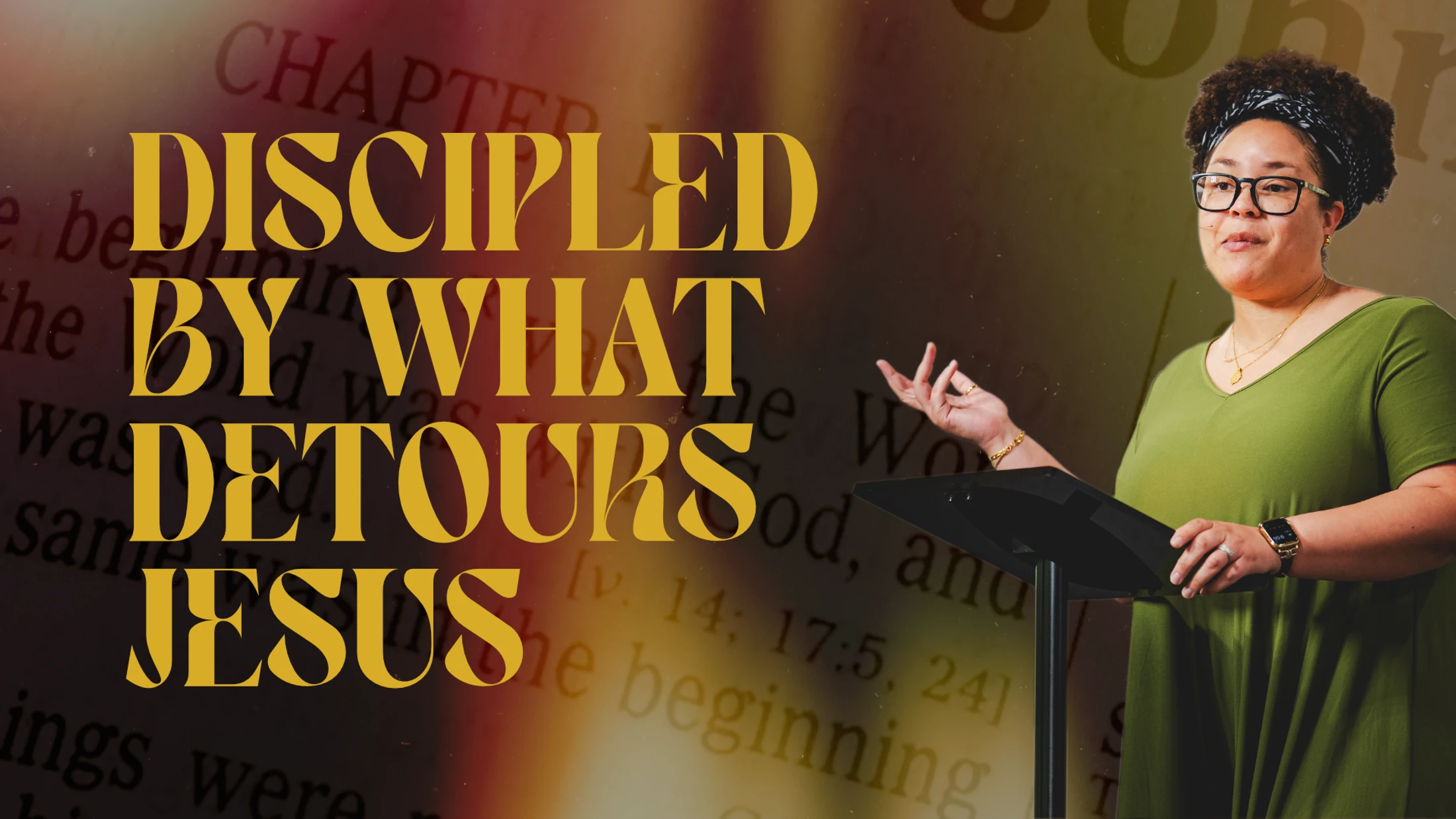
You can tell a lot about a person by what distracts them. What grabs their attention when they're focused on something else. What makes them stop, change course, and pay a cost they didn't plan to pay.
In this message, Pastor Micah Morgan takes us into John chapter 2 — and instead of focusing on what Jesus did, asks us to pay attention to what detoured him. From a wedding running out of wine to money changers blocking the vulnerable from accessing God, we watch Jesus get pulled off his own agenda twice. And in both moments, we learn something profound about what it means to actually follow him.
Because following Jesus isn't just about going where he's going. It's about being detoured by the same things that detour him.
In this message you'll learn:
Whether you're someone who wants to serve but doesn't know where to start, or someone who is burned out from giving too much, this message will challenge and encourage you to pay attention to who around you is being kept from what they deserve — and ask Jesus what your next step might be.
📖 Scripture: John 2:7-17 | Genesis 18:19
Well, we are continuing with our sermon series this morning, the Gospel of John, and really what we are trying to do is to reintroduce ourselves to Jesus, the Jesus who is fully embodying the 100% substance of God and is also 100% human. And we're trying to ask ourselves, what does it mean to follow this Son of God. And so today we're going to be exploring John chapter 2. And before we jump in, I want to invite you on a short visualization, if you will, okay? So it's a Wednesday morning, you accidentally oversleep, you didn't hear your alarm wake you up for an important meeting that someone decided to schedule right at the beginning of your workday. You wake up with just 30 minutes to get dressed, even though it usually takes you about 45, but miraculously, you get fully ready in time to leave the house with 23 minutes to get to work. This is the exact amount of time that you need to get to your job and this really important meeting. You're thinking, "OK, cool, I can still make it. I can drive, you know, 23 minutes, get there, park." You hop in the car, you pull into traffic, and everything is going smoothly for about 15 minutes of your commute, and you see this in front of you. Stop and go. Mm-hmm. These signs are sitting in the middle of the road that you have taken for months, maybe even years, to get to work in those 23 minutes, and you know immediately that you're going to be late. Now, there's no version of this scenario that you can think of because you've driven these roads for so long. You can't think of a way that you can still make it to work in those 23 minutes. So here's the question: What keeps you driving forward on that journey to get to that important meeting? What keeps you driving is that you know that you have to get to work. This is important. There is value in you continuing past this detour. There's something important on the other side of the detour that motivates you to eat the cost of that detour. Did you know that there is also a part of our personality that gets shaped by what detours us? Many of you are familiar with the Enneagram, which is a personality tool used for personal growth and spiritual formation that focuses on our core motivations, our blind spots, our unconscious patterns. But have you ever seen the Enneagram described in terms of what distracts and detours us? This is the list that I tend to use with folks as I serve as a therapist and as I do pastoral meetings with folks, it's this list of understanding our Enneagram types in terms of what distracts us. For example, an Enneagram 9 is often distracted by the absence of peace. An Enneagram 8 is often distracted by betrayal and protection. A 7 is often distracted by adventure. A 6 by distracted by risk, a 5 by interesting ideas. A 4 is often distracted by beauty, a 3 often distracted by goals and efficiency, a 2 often distracted by unmet needs, and a 1, which I am, often distracted by injustice and imperfection. You can tell a lot about a person, not everything, but a lot, based on what tends to distract them, based on what captures their attention and detours them even when they're focused on something completely different in the moment. You can learn a lot about a person in terms of what keeps them moving beyond a detour as well. It tells a story about what they're willing to sacrifice, why they're willing to sacrifice, And so today we're going to explore two moments in John chapter 2 where I believe we watch Jesus actually get distracted and detoured. We watch Jesus's attention get grabbed by something and he decides to embark on a whole different plan altogether. And in these two moments, not only do we learn a lot about Jesus, but we also learn a lot about what it means to to follow Jesus. And so the main idea that I want to offer for today's sermon is this: as followers of Jesus, we don't just follow Jesus where he is going, but we also commit to being detoured by the same things that detours Jesus. I've called this sermon Discipled by What Detours Jesus. Discipled by What Detours Jesus. Let's pray and then spend a little time just discovering what scripture has today. Lord, thank you for an opportunity to spend some time with Jesus today, and not only watching him do what he does in his ministry and his mission, but also watching him get distracted and detoured. Lord, help us to listen deeply for what these detours today in John chapter 2 can teach us about what's important to Jesus and therefore what should be important to us. Lord, you are faithful and we know that your word is good and true. In Jesus' name I pray, amen. So I'm not going to have you stand, but I would love to have you just remain in your seats and read John chapter 2, verses 7 through 17 together. Let's read. Fill the jars with water, Jesus told them. So they filled them to the brim. Then he said to them, now draw some out and take it to the head waiter. 'And they did. Then the headwaiter tasted the water after it had become wine. He did not know where it came from, though the servants who had drawn the water knew. He called the groom and told him, "Everyone sets out the fine wine first. Then, after people are drunk, the inferior." But you have kept the fine wine until now. Jesus did this, the first of his signs, in Cana of Galilee. He revealed his glory, and his disciples believed in him. After this, he went down to Capernaum together with his mother, his brothers, and his disciples, and they stayed there only a few days. The Jewish Passover was near, and so Jesus went up to Jerusalem. In the temple, he found people selling oxen, sheep, and doves, and he also found the money changers sitting there. After making a whip out of cords, he drove everyone out of the temple with their sheep and oxen He also poured out the money changers' coins and overturned the tables. He told those who were selling doves, "Get these things out of here. Stop turning my Father's house into a marketplace." And his disciples remembered that it is written, "Zeal for your house will consume me." Amen. This is the word of the Lord, and the people said, Thanks be to God. I pray that this would fill our minds, flow from our mouths, and free our hearts to help us live as the beloved people of God. So in these verses that we just read, just to offer us a little bit of a summary, we have these two moments where Jesus is focused on one thing but gets detoured by another. In the first situation, Jesus is focused on enjoying the wedding festivities and avoiding revealing his glory and mission sooner than planned. But then he gets detoured by a crisis of honor at the wedding. Here's the part of the interaction that we didn't read together that happens before verse 7. In verses 3 and 4, we see Jesus's mother come up to him and just say a few words, "They don't have any wine." And Jesus responds in verse 4 by saying, well, 'What has this concern of yours to do with me?' Jesus said, 'My hour has not yet come.' What's happening here is we see this, this cultural dynamic. It was a Jewish custom for weddings to span about 7 days of celebration because this was a joyous occasion. And during those 7 days, what was typical is that if there was a host providing those festivities, they were going to make sure that everyone that came came was fed and that they were suitably— had access to as much wine as they needed. But what we see here is that they've run out of wine just a few days into the festivities and Mary, Jesus's mother, comes up to Jesus and shares this problem with him. But what's important for us to notice is that because this was a shame-honor culture, this wasn't just an embarrassing moment, but this was an issue of dishonor for the host. If people within that wedding party, people who were coming to celebrate the festivities, noticed that the wine had run out, it would bring dishonor on the family of the bride and the groom. So Jesus responds to his mother with what can feel like a very short and terse response. But listen to what scholar Gary Burge says about the way that Jesus responds. Jesus's response is not rude, but it is simply inflexible. "Why do you involve me?" is literally, "What do we have in common?" or as a paraphrase, "How can this matter that concerns you be of mutual interest to us?" This is what scholar Gary Burge is saying that Jesus is saying in between the lines. How can this thing that you're bringing to me be mutually of interest to both of us. Jesus's orientation for activity, his focus, is elsewhere. "My time has not yet come," Jesus says. So Jesus wasn't being rude. Jesus was merely saying back to his mother, "Mom, you know I'm not trying to let people know what I can do just yet." And Mary turns to the servants and she says, "Whatever Jesus tells you to do, go ahead and do it." And so Jesus allows himself to be detoured. Then the story continues. Jesus continues along his journey and he travels with his disciples. We see in verse 12 that he leaves Cana and he heads to the city of Jerusalem so that they can celebrate the Jewish festivals associated with Passover. Now here's what I want to remind us of: Jesus was a Jewish man. And so the Passover festival would have been very important to Jesus. If you're not familiar with Passover, this is an annual festival where they celebrated the retelling of the story of Israel's departure from Egypt that we read about in Exodus. Israelite families from all over the area were expected to come back or make a pilgrimage back into Jerusalem so that they can participate in sacrifices, in a symbolic meal, and the reflective study of Israel's spiritual journey. But what does Jesus see out of the corner of his eye as he's heading back toward Jerusalem? He sees people in the outer courts of the temple selling oxen, sheep, and doves. And then he also found what are called money changers. Money changers were people who understood that there were lots of Jewish people coming from many different areas descending upon the same city, and so they were gonna need to have currency translated from their homes that could be used in the city. And so money changers were there saying, "Okay, I'll give you, you know, this much money of your kind of money for the money that you need here." Bible scholars believe that there was a period of debate, actually, before this moment in history where the Jewish leadership were trying to figure out, is it permissible to allow people to sell things in the outer courts? Of the temple. Is this something that's going to tarnish God's original vision for what the temple is going to be for? Some people were on one side saying, "Yes, it's going to tarnish God's vision. Do not allow people to sell things in the outer court of the temples." And then other people were saying, "Well, if we don't, then people can't buy the animals that they need to sacrifice for the festival." Team B won. They allowed the selling of the doves, the sheep, the lambs, and the money changing to make sure that people had what they needed to make the sacrifices. But Jesus disagrees. Jesus sees what is happening, and I want to just invite you to imagine what Jesus sees in this moment. He's looking at all of this, all of this commerce happening in the outer courts of the temple. And then behind the pillars of the temple, he is seeing people who don't feel welcome to come into those outer courts because they don't have any money to change over, or they're not wealthy enough to buy the animals that they need to sacrifice. They're just gonna use some animals that they've been raising in their own estate. So there were people who didn't feel welcome enough to come into the temple of God because this had become a border of commerce before you could get into the presence of God. Jesus saw this, allowed himself to be distracted, and then he did something about it. Here is what scholar Gary Burge says about this moment: Jesus is acting out of his relationship with the Father. As Messiah and God's Son, he is driven to defend and promote God's interests in the world. When he sees the human ruin of God's house, he is overwhelmed with a desire to act. Jesus sees the way that this arrangement was impacting the underserved of this community, and he knows, because he holds within himself the full substance of God, he knows that God's heart breaks when the vulnerable don't have the same access as the privileged. And so what Jesus did was instead of keeping himself focused on his own agenda, keeping himself moving toward his own celebration of the Passover, he allows himself to get detoured and he goes into the temple courts and flips those tables so that the vulnerable has the same access to the privileged. So in summary, here's what I want to invite us to notice about these scriptures. Jesus, in the beginning of chapter 2, is focused on his ministry schedule. In his mind, he's got a schedule of when it is going to be suitable for people to find out that he's more than just the carpenter that was raised by Mary and Joseph. But instead, he gets detoured by the people's need for honor. Then we continue and we see that Jesus is focused on attending the Passover festival, but he allows himself to get detoured by the people's need for advocacy and justice. But here's what we haven't talked about yet. We haven't talked about the cost. Anytime someone allows themselves to get detoured by the needs of others, there's going to be a cost, and I think we don't talk about that enough. We like the heroism of saying, "Oh yes, I was very righteous and I allowed myself to put others' needs before my own." But we don't talk about the risk that we take on when we do that. The energy that we expel when we do that. The grief that we feel when we set aside our own agenda because you literally can't focus on two at the same time. The cost of investing in and being detoured by the needs of others is something that we need to take into account. What it cost Jesus to turn water into wine was now this word about him being more than just a carpenter was out. Now Jesus is being launched into his ministry perhaps sooner than he originally planned. The cost that Jesus spent when he went into the temple and he flipped those tables for the vulnerable was he created enemies out of the Sanhedrin, out of the Jewish leaders. That put Jesus on their naughty list, if you will. And we track how that followed Jesus for the rest of the Gospels. Those leaders did not like him. And then they eventually killed him. Any time we allow ourselves to be detoured by the needs of others, we have to also be honest about the cost. But this is the reality of the world that we live in. Making sure that the vulnerable have the same access to the things that the privileged have access to means that we are going to be willing to risk something so that we bless the underserved. There's a real-life story about this from the American Red Cross in Milwaukee. Several years ago, they started experiencing a volunteer shortage. And in order to kind of accommodate for the volunteer shortage, what they did was they found 10 low-income zip codes where they essentially asked them, listen, if you have a house fire in this area, in one of these 10 zip codes, we're just, we're just asking you to drive to these nearest locations so that you can get the help that you need. Now, on the one hand, when we hear this story about the Milwaukee Red Cross, we're hearing that they're trying to accommodate for their own need, which is to have enough volunteers to serve the folks that they need to serve. But immediately after making this announcement, there were leaders within the community that said, listen, you actually are engaging in a form of redlining. You're actually engaging in a form of discrimination because the 10 zip codes that you have chosen for this new initiative happen to be mostly people of color and mostly low-income families. But listen to the way that Patty Flowers, the Red Cross regional chief executive officer, responds after she gets this feedback. She says, "In an effort to continue to serve people affected by house fires, we recently implemented new procedures in Milwaukee that we now understand were insensitive to the communities we serve. We apologize for this mistake and will immediately return to the way that we have responded to house fires in the past." consistent with American Red Cross practices and values nationwide. The Red Cross pivoted. They heard that their decision had negatively impacted vulnerable communities, and instead of holding their ground, instead of digging in their heels, they apologized and they said, "You know what? We're gonna take on the risk." They started sending volunteers back out to the homes of those 10 zip codes, even though they still didn't have enough volunteers. And they said, "In order for us not to engage in these discriminatory practices, we are going to send people out the same way we send them, whether they're in this zip code or another." But what motivates Jesus and people like Patty with the Red Cross to engage in costly behavior for the sake of others? What must be important to Jesus and to people like Patty in order for them to be willing to be detoured for the sake of others? I would argue that in order for anyone to be willing to be detoured for the needs of others, they have to have this vision of what people deserve. We have to be willing to have a list in our minds of what we believe everyone is deserving of simply because they are human. I want to read to you a moment where God speaks about Abraham in Genesis chapter 18 and 19, where he talks about the reason why he chose Abraham for the mission of blessing all of the nations through his lineage. In verse 19, God says, "No, for I have chosen Abraham that he may charge his children and his household after him to keep the way of the Lord by doing righteousness and justice, so that the Lord may bring about for Abraham what he has promised to him." The Hebrew phrase that the writers in Genesis say that is used here for the way of the Lord, doing righteousness and justice, is this phrase phrase "tzedakah y'mishpat," "tzedakah y'mishpat." And this is really a way to describe what it looks like for the people of God, beginning with Abraham, to set everything right again that has been broken from Genesis 3 and on. This is the work that we're all involved in as followers of Jesus. But what does tzedakah u'mishpat mean? We have another scholar that we can look to to answer this question, Rabbi Jonathan Sacks. He actually gives us a really helpful description of what mishpat and tzedakah are. He says that the way of the Lord is defined here by two words, tzedakah and mishpat. They are both forms of justice but are quite different in their logic. Mishpat means retributive justice. It refers to the rule of law through which disputes are settled by right rather than might. But here's the one that we don't talk about a lot. Tzedakah is the phrase that came— the nearest thing that we have to tzedakah is a phrase that came into existence when we started talking about a welfare state, and that is social justice. The closest phrase that we have to tzedakah, that Hebrew word, is social justice. Behind both is the idea that no one should be without the basic requirements of existence, and that those who have more than they need must share some of that surplus with those who have less. So tzedakah, this righteousness and justice that God said that he was trusting Abraham to put into action, is the belief that there are basic requirements that everyone is deserving of simply because they bear the image of God. Is that something that we hear a lot, family? That everyone is deserving of the same thing regardless of what they look like, what they've done, who they know? Or has the empire told us that there are only certain people who get to have their basic needs met if they can afford them? If they are connected with the right people? If they look like we think they should look? As a Jewish man, I believe that Jesus would have had this concept of tzedakah y'mishpat in his mind. As he moved through the world, as he taught people what it looked like to love God with all your heart, your mind, and your soul, and to love your neighbor as yourself, I believe that he had this Jewish concept in his mind that said, you know what, it doesn't actually matter what you look like and what you've done. Because you bear the image of God, there are things that you are due. Safety. Sustenance, respect, belonging. And what we see in the wedding of Cana is maybe Jesus also believed that people deserve joy. Maybe he believes that people deserve enjoyment, to enjoy the environment around them, even if it means being able to drink a little extra good wine at a wedding festival. Jesus is teaching us that if we are going to follow him, we must also be willing to be detoured by the same things that detours him. And so here's one thought that I want to just leave you with that just kind of summarizes this whole thing. If we are to be discipled by what detours Jesus, We must also find important what Jesus found important: that every human deserves to have the same basic core needs met: safety, sustenance, respect, belonging, and joy. But we must also be willing to pay the cost of meeting those needs. So, family, as I close, here is my hope for us today. My hope is first that we will remember that the reality of living in a world that is not yet fully healed by the work of Jesus means that everyone's needs are not met equitably. That is what it means to live in this world. But that doesn't change the reality that when God created us, God intended for all of us to experience the abundance that God put on this earth. And so my second hope, family, is that we would be distractible. My second hope, family, is that we would be willing to constantly look out into the world and ask the question, what are the basic needs that folks are not getting met? And I want to invite us to be more creative than just the need of money. Yes, of course, financial resources are incredibly important for us to live and to thrive, but there are other needs needs that were due that Jesus demonstrates in these scriptures. The need for joy, for pleasure, the need to be protected, to have the same access to God that everyone else has. That's what we see when he flipped the tables in the temple. I want to invite us to be curious about what are the things that people are being kept from experiencing, and how might I be able to use my gifts my talents, my treasures, my time to help ensure that those barriers are removed. And so here are some reflections and action steps that you can take with you in the following week. I want to invite you to reflect on what you might add or take away to the following list of needs that I've been offering to you. When you look at this list of needs— safety, sustenance, respect, belonging, and joy— is there anything that you would add to that where you would say, simply because we are image bearers of God, we also all deserve this? And then secondly, I want to invite you to pray. I want to invite you to say to the Lord, Lord, who are the people within my reach whose needs are not being met? And would you help me to prepare for the cost of serving them? Family, if you spent any time listening to us preach here, you know that we don't just talk about martyrdom. We don't just talk about, okay, just expend yourselves until you're empty for the sake of others. That's not what I'm inviting you into. I'm inviting you into the complexity of asking the question, Do I have the capacity to pay the cost of serving others? Sometimes that question is yes, yeah, I got a little extra in my tank, I can manage the cost of serving others. Sometimes it's not. And so, family, I want you to know that there is no shame in you making that decision wisely and with complexity. But what I want to invite us away from is just saying that being comfortable is the only litmus test that we use for service. Sometimes the cost of serving others is our discomfort. That is what Jesus shows in this moment in the wedding of Cana, at Cana. The discomfort of having to reveal his glory earlier than planned. Can you imagine that? Jesus knows these Jewish leaders. He knows that it's not gonna be a walk in the park if he shows them who he is sooner than planned. Jesus was uncomfortable for the sake of this family. And some may argue that simply giving them honor, simply giving them the joy of good wine, wasn't reason enough for Jesus to be uncomfortable, and yet he made the decision anyway. So I just want to invite you to pray with Jesus honestly. Lord, what will be the cost and how will I pay it? And then finally, I want to invite you to act. And again, I want to invite you to get creative. Engage in one act of service, to do something on the behalf of someone. Whose needs are not getting met. It can be as simple as you're at a meeting at work and you notice that somebody is not given the space to speak up and share their discomfort with an initiative. Maybe you're the one who speaks and says, "You know what, I wonder if we're not taking into account this," and you amplify the voice of someone who isn't being heard. Or maybe you decide to put together some care packages for the unhoused and you keep 5 of them in your car so that if you see someone who is unhoused downtown or in the community, you have something that you can give them. There's always a creative way that we can prepare to serve the needs of others. Let's pray. Lord, I thank you that you have given us the example of Jesus to show us what it looks like to be detoured for the sake of others. And Lord, I thank you that the example that Jesus gave us is not one of toxic positivity, but we can also see that there was a cost that Jesus paid in order to be distracted in order to serve the people in his community. And so, Lord, I thank you that we don't have to walk away from this scripture with a lopsided view of what it means to follow Jesus. So, Lord, as you continue to nurture us in the wisdom of this scripture, I pray that you do it while reminding us that you love us, that there is therefore now no condemnation and no shame for those who are in Christ Jesus. But that there is opportunity to continually grow in our Christ-likeness. Lord, you are faithful and we thank you. In Jesus' name I pray, amen.