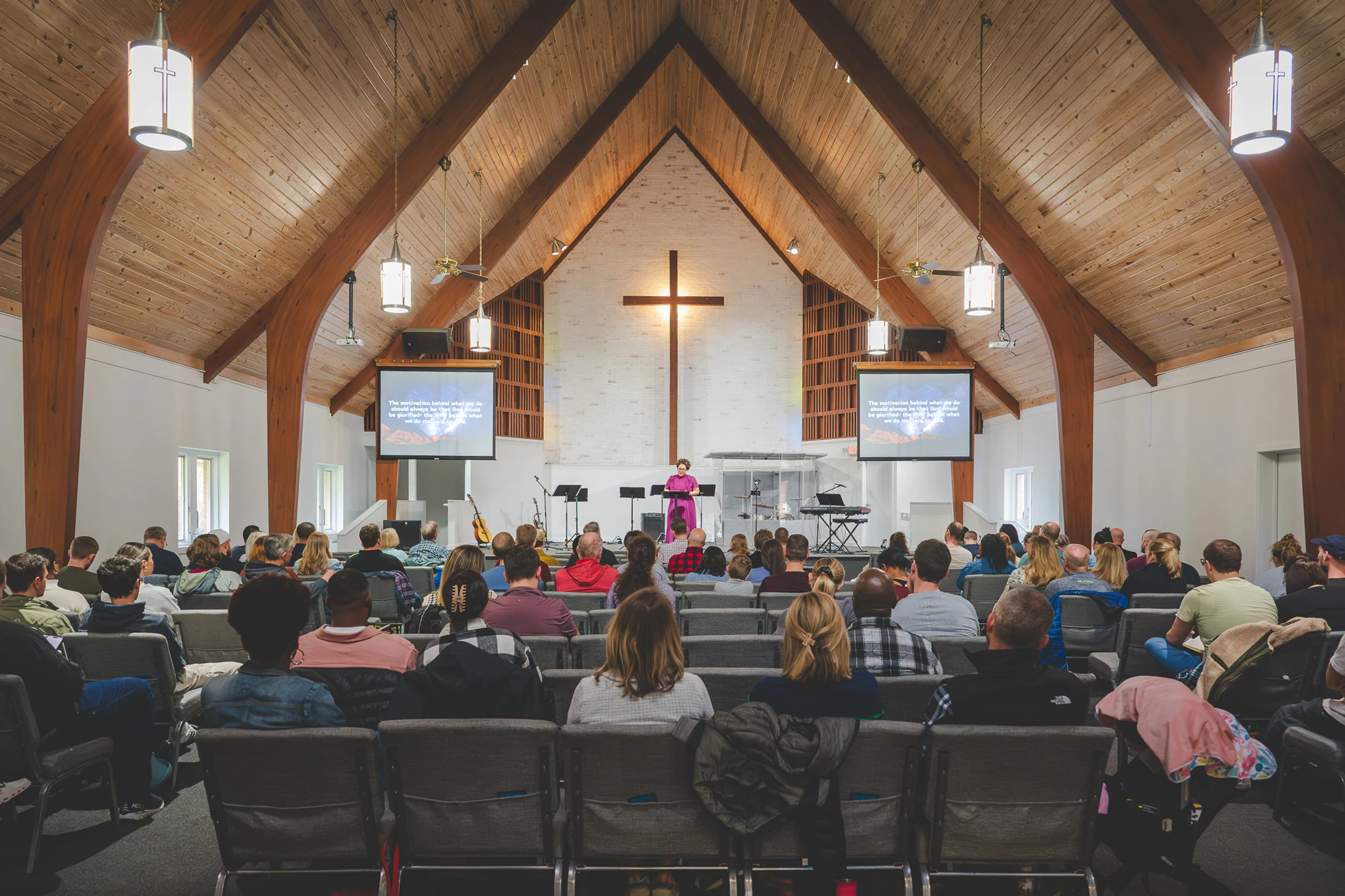
We can't wait to see you
Join us this Sunday at 10:00 a.m. for our morning worship!


When everything is going well, it's easy to sing about God's goodness. It's easy to talk about his faithfulness when the bills are paid, the diagnosis is clear, and the people we love are thriving.
But the moment the bottom drops out — the moment the phone rings at 2AM, the job disappears, or the relationship splinters — how quickly we forget everything God has ever done for us.
Here's the good news: forgetting isn't the end of the story. There's a way back.
In this message, Devin Schaffer takes us into Psalm 77 — one of the most honest, raw, and ultimately hopeful psalms in all of Scripture — written by Asaph, Israel's worship leader, a man whose job was to remind everyone else about God's faithfulness while privately drowning in his own despair. And through Asaph's journey from anguish to anchor, we discover that the way out of spiritual amnesia isn't waiting for the feeling of faith to return. It's making a defiant, deliberate choice to remember.
Asaph didn't feel his way to hope. He remembered his way there. And so can you.
In this message you'll learn:
Whether you're in verses 1 through 10 — trapped in the question of whether God has forgotten to be merciful — or you're ready to make the turn of verse 11, this message is for you. Because Asaph looked back to the Red Sea. We get to look back to the cross. And if God didn't hold back his own Son to save you, he is not walking away from you now.
The story never ends at verse 10.
📖 Scripture: Psalm 77:1-15 | Isaiah 55:8-9 | Romans 8:32
A little background. My name is Devin Schaefer. I would introduce my lovely wife and kids, but they're at the Obama Museum this weekend. And my sister-in-love wanted to go much more than I did, so I gave her my ticket. So I'm here preaching with you guys, and I appreciate the opportunity that Pastor Rich provides for us lay individuals that have a word to share. Now, the one thing Pastor Rich asked me to do is— well, it's 2 things. The first is he said, because the title of our sermon series is The Reason Why We Sing, that I need to sing a song. And I told him no dice, that I'm a backup singer at best. And so I told him if he wants me to come up and do backup for him when he sings or something, I'll do that. The second thing he asked the preaching group to do is because it's summer, although we're working through some heavy material, he wants us to leave you with a word of encouragement. So when I say I need your patience, I need your patience because the scripture that we're working through today starts off a little rough, but I think the Holy Spirit will get us there where we get to a point of encouragement. So I'll dive in. Have you ever noticed how quickly we suffer from spiritual amnesia? When everything is going well, it's easy to sing about God's goodness. It's easy to talk about his faithfulness when the bills are paid, the diagnosis is clear, and our families are thriving. But the moment the bottom drops out, the moment the phone rings at 2:00 AM, Or the job is lost, or the relationship splinters, how quickly we forget everything God has ever done for us. Here's the good news before we go any further. Forgetting isn't the end of the story. There's a way back. And Asaph, a man who wrote Psalm 77, is going to show us exactly what it looks like, because it's so easy to become a prisoner of, of the moment. Amen. And if you ever felt that way, you're in good company. So please open your Bibles to Psalm 77, and we're going to read verses 1 through 15. And if you don't mind standing with me, we'll read those together. I cried out to God for help. I cried out to God to hear me. When I was in distress, I sought the Lord. At night I stretched out untiring hands, and I would not be comforted. I remembered you, God, and I groaned. I meditated, and my spirit grew faint. You kept my eyes from closing. I was too troubled to speak. I thought about the former days, the years of long ago. I remember my songs in the night. My heart meditated and my spirit asked, will the Lord reject forever? Will he never show his favor again? Has his unfailing love vanished forever? Has his promise failed for all time? Has God forgotten to be merciful? Has he in anger withheld his compassion? Then I thought, to this I will appeal: the years when the Most High stretched out his right hand. I will remember the deeds of the Lord; yes, I will remember your miracles of long ago. I will consider all your works and meditate on all your mighty deeds. Your ways, God, are holy; what god is as great as our God? You are the God who performs miracles. You display your power among the peoples. With your mighty arm, you redeemed your people, the descendants of Jacob and Joseph. The word of God. Thanks be to God. You can be seated. So as I mentioned, this psalm was written by a man named Asaph, and Asaph wasn't a casual believer. He was a worship leader, a professional at reminding other people how the goodness— about the goodness of God. Yet as we read the first 10 verses of this psalm, we see a man drowning in despair. Look at how he opens in verses 1 through 3. This isn't a polite morning devotional with your cup of coffee. He's crying out loud to God. And he says plainly that even when he reaches for God in the night, comfort does not come. He's not giving up. He keeps pleading, but the relief he's looking for simply isn't arriving. Then in verses 4 through 6, something worth noting happens. He can't sleep. He's so troubled he can't even speak. And when he tries to do the thing every counselor and every pastor tells you to do in a hard season, To remember the good years, think back on happier songs in the night, it doesn't comfort him. It makes things worse. His own heart starts interrogating him, asking hard questions that he can't answer. That detail matters because it sets up our whole discussion today. Remembering isn't automatically healing. Done the wrong way, memory can become another room in the house of despair. Yeah. Asaph proves that before he ever shows us the better way— but stay with him. The same man who gets crushed by his memories in verse 6 is about to be rescued by memory in verse 11. And if he can find his way from one to the other, so can you, and myself included. So by verse 10, he names what was happening to him directly. This, he says, is his wound. The thing— the things that changed since God seemed to act differently than he used to. And right on the heels of that admission come the questions in verses 7 through 9. Will the Lord reject forever? Will he never show his favor again? Has his unfailing love vanished forever? Has his promise failed for all time? Has God forgotten to be merciful? Those are not words of a polished Sunday morning Christian having a mild bad day. Those are words of a soul in agony. Asaph is looking at his current circumstances and he cannot reconcile the pain he is feeling with the God that he thought he knew. But then something shifts, and this is the turn I want to talk— I want you to walk out of here holding on to today. Right in the middle of the psalm, the trajectory changes. Asaph doesn't get a sudden change in circumstances. His problems don't magically vanish. Instead, he changes his focus. He makes a deliberate, hope-filled choice. That choice is found in our main text today, starting in verse 11. He says, I will remember the deeds of the Lord. Yes, I will remember your miracles of long ago. I will consider all of your works and meditate on all your mighty deeds. Your ways, God, are holy. What God is as great as our God? You are the God who performs miracles. You display your power among the peoples. With your mighty arm, you redeemed your people, the descendants of Jacob and Joseph. Today we're going to look at 3 anchors from this text that can hold us steady when When the storms of life try to wash away our faith. So the first anchor is just the defiant act of remembering. And I want you to look closely at the language Asaph uses in verses 11 and 12. He says, I will remember, I will consider, I will meditate. Notice, notice what's missing. He doesn't say, I feel like remembering. He says, I will. That's right. This is an act of the will. It is a defiant rebellion against the despair trying to consume him. When you're in a season of deep pain, your emotions will lie to you. Your fear will tell you God has abandoned you. If you wait for the feeling of faith to wash over you, you might be waiting a very long time. And I want to talk about a gentleman named William Cowper to To illustrate how to move in these seasons in this first anchor. William was one of the most gifted poets of the 18th century in England, and he battled severe depression his entire adult life. This depression was dark enough that it drove him to attempt suicide more than once. In one of his earliest and darkest collapses in his early 30s, he ended up in an asylum under the care of a Christian doctor. In that place, at what should have been the lowest point of his life, he picked up a Bible lying nearby. It fell open to Romans, and something in that moment broke through. Not a new argument, not new information that he hadn't heard before, just God's character freshly remembered, meeting him exactly where Asaph— where Asaph is in Psalm 77. And that encounter became Williams' conversion. But here's what's important. The depression didn't leave him after that, after he was converted. About a decade later, grief and slander piled up again, and the darkness came back as hard as ever. It was in the middle of that second collapse, not after it lifted, that Cowper sat down and wrote what's become one of the most beloved hymns in church history. About God's providence being trustworthy, even when it's completely invisible to us. He didn't write it once the depression was gone. He wrote it while he was still in it, the same way Asaph doesn't wait for relief before he starts rehearsing God's mighty deeds. He preaches to himself first, and the comfort follows, not the other way around. And that's the exact move in verse 11. Cowper didn't feel his way to hope. You know, he had to remember his way there. Cowper borrowed light from the past to get through a darkness the present couldn't explain. That's exactly what Asaph is doing in, in verse 11. He says he will consider and meditate. This isn't a passing thought. It's a deep, sustained reflection. What has God brought you through before? What prayers has he answered? What doors did he open 5 years ago that you thought would be shut forever? Write them down, speak them out loud. Your memory of God's past faithfulness is one of the strongest weapons you have against your current fear. And every single one of you in this, in this room has more evidence of God's goodness than you're giving yourselves credit for this morning. So let's shift to anchor 2. Anchor 2 is just the holiness and mystery of God, and this can be a tough one for us. Once Asaph forces his mind to look backward, he arrives at a realization in verse 13. Your ways, God, are holy. What God is as great as our God? As many of you know, holy means set apart, just wholly other, other than. When Asaph says God's ways are holy, he's acknowledging something both comforting and genuinely hard. God does not do things the way we would do them. I'll repeat that. God does not do things the way that we, that we would do them. If we were God, we'd insulate the people we love from pain. We'd end sickness and financial struggle on our own timetable. We want a God who operates like a vending machine. Good behavior in, painless life out. But God's ways are holy. They run on a scale our finite minds do not fully grasp. In Isaiah 55:8-9, it says plainly, for my thoughts are not your thoughts, neither are your ways my ways, declares the Lord. And I want to be honest with you. Verse 13 doesn't answer why. It doesn't explain the diagnosis, the layoff, the child who won't call home. If you're waiting for this sermon to hand you a reason that makes the pain make sense, I don't have one. And neither did Asaph. What he found instead was a who strong enough to hold the why he never got answered. Amen. And here's the encouraging part. That's enough. You don't need every answer to have real peace. You just need to trust that some— you need to trust the someone, God, who has them. And that's not a consolation prize. That's actually a lighter thing to carry than the answers would have been. And I just want to, before we move to the 3rd anchor, I want to pause and talk a little bit about communal and personal trauma. And I want to, you know, I think it's worth naming it plainly. Pain doesn't always come to us one person at a time. Sometimes it moves through entire families, entire communities, entire generations. And I'm going to use just the African American population in America as a clear example. For generations, our community has carried the weight of slavery, And in the century after emancipation, segregation, violence, and exclusion aimed specifically at us as a people. This was a communal trauma, some of which in different forms is still being felt today. That is a real historical corporate wound. It deserves to be named honestly, not minimized, and not rushed past. And here's the tension I want us to sit in for a moment. Naming that communal trauma does not and must not diminish anyone else's pain. The grief of a father who lost his son in a car accident last spring is not smaller because it wasn't shared by millions of people. The anguish of a woman fighting cancer alone with no family nearby is not less real because no history book will ever mention it. Communal trauma and individual trauma are not in competition with each other. They don't rank. God does not run a hierarchy of whose pain matters more. And this is exactly the tension Asaph is caught in. He wasn't an outsider shaking his fist at God that he never trusted. He was Israel's worship leader, a man whose job was to stand in front of the whole assembly and declare God's faithfulness on behalf of everyone. He carried his people's story. Their slavery in Egypt, their wilderness years, their long and complicated history with God. And underneath that corporate memory, he was also carrying something entirely his own, a private anguish never named in the text, real enough to steal his sleep and silence his voice. Maybe that's some of you this morning. Maybe you carry the weight of something that happened to your people, A history that shaped your family long before you were born. And maybe you're also carrying something that belongs to you alone, something no history book will ever record, something only you and God know the full weight of. Both of these— both of those are real. Both of those matter to God. And faithfully serving him, leading worship, teaching a class, showing up every single Sunday, it doesn't exempt you from either one. Asaph proves that faithful service and deep pain can occupy the same life at the same time. So let's transition to anchor 3, which is the proof of redemption, and it's verses 14 through 15. Finally, Asaph moves from general remembrance to a specific historical anchor, his own people's communal story. You are the God who performs miracles. You display your power among the peoples. With your mighty arm, you redeem your people, the descendants of Jacob and Joseph. He reaches back to the defining moment of Israel's history, the Exodus. This wasn't a private rescue. An entire people had been enslaved for 400 years, long enough that it must have looked like God had simply moved on from them collectively. But he was working in the dark, preparing a deliverer and eventually splitting the sea to walk them out of bondage together. Why bring this up? Because the Exodus was proof that God is a redeemer. He doesn't display power to show off. He displays it to rescue his people. Church, if Asaph could find comfort in the Exodus, how much more, how much more Can we find it in what came after? We have a better rescue to look back on. Asaph looked back to the Red Sea. We get to look back to the cross. When you're sitting in the dark wondering if God still loves you, you don't have to reach for, um, a sea being parted. You can reach for a temple veil torn in 2 and a son who took the weight of your sin onto his own shoulders. Amen. Before he ever asked you to carry it. If you doubt God's power, look at the empty tomb. If you doubt God's love, look at the scars in his hands. Romans 8:32 reads, he who did not spare his own Son but gave him up for all— for us all, how will he not also, along with him, graciously give us all things? The cross is the strongest evidence you'll ever get that God will not abandon you. If he didn't hold back his own son to save you, he is not walking away from you now because you lost a job or your marriage is fraying or you failed at something that mattered. His arm has already reached into the darkest grave in history and pulled out life. He can reach into whatever you're carrying too. So in closing, what I would love for us to do today is think about writing your own Psalm 77. And the question I ask you is, you know, where are you living right now? Are you in verses 1 through 10, trapped in, has God forgotten to be merciful? Or are you ready to make that turn of verse 11? I'm not asking you to pretend everything is fine. God doesn't need your fake positivity. Asaph was brutally honest about his pain, and God put those words directly into inspired scripture. It's okay to hurt. It's okay to grieve. But don't let the darkness have the final word. It doesn't get to. It never did. Not for Asaph and not for you. What I would ask you to do is this week, take a piece of paper, write down your own Psalm 77. Not 3 bullet points, a short paragraph in your own voice following Asaph's pattern. First, name what's actually true about where you are right now, because I think it's good for us to take that inventory and ask questions about where we are emotionally, especially, and spiritually. And do that the way that Asaph did in verses 1 through 10. Yeah. And I'm going to implore you, don't sand off the edges. You know, you could be in a really bad place right now, and that's okay. That's life. We live in a fallen world. But next, I want you to write, but I will remember, and list 2 or 3 specific things. A time God provided for you when you saw no way out. A moment he comforted you in when you were genuinely broken. And end it the way that Asaph ends, not with your circumstances resolved, but with the declaration of who God is. And I would ask that you keep that page somewhere, you know, close to you where you can actually see it. The dashboard, the bathroom mirror, tucked in your Bible. And when the panic starts to rise, don't just read it, say it out loud the way Asaph did. Asaph, I will remember the deeds of the Lord. His ways are holy, and he has redeemed me. Because I just want us to understand, you know, I do feel like we live in the most prosperous nation in the world, and I believe our standard of living is so high that we don't really appreciate it. And it's human nature, right? We get used to things, but just appreciating That it's not going to always go well. Like, you're not going to always get the promotion. You may lose a job. You're going to have death. You're going to have these things. But that doesn't change who God is. It's really, really important. And I also want to just touch on the fact that spiritual warfare is real. And I like to tell people it's incremental. I think sometimes we think of the evil one and we think of these spectacular instances that are going to, like, be jarring. Instead, I truly believe he operates very, very incrementally and very intentionally. And so all those little things that happen in our lives where we get triggered, he's winning. Now, that doesn't mean it's our fault that we get triggered. We've gone through trauma. God knows our frame. He knows our frailty. But he's also given us so many things that we can look to in the past. And I know for myself, I still get triggered 100%, but I am doing much better at addressing that trigger when it happens rather than going down the deep road and then realizing like, man, what am I doing thinking about all this stuff and getting back on track? So I really hope you guys will think about writing those things down just because the act of writing and thinking through will just help you to know yourself better. You may write some things that you didn't that you didn't even think you would articulate when you write it, and so that we can just keep in mind who God is and what he'll do for us. Let's pray. Heavenly Father, we confess that we are prone to forget. We are easily blinded by the storms right in front of our faces. Give us the grace to remember your track record, your cross. When our feelings tell us you have left us, Anchor us to the truth that you are the God who redeems. Thank you that the story doesn't end in verse 10, that you always make a way to verse 11. Send us out of this room together lighter than we came in. In Jesus' name, amen. Amen.